Agentic AI Can Reach GDS. What Must It Prove Before Engineers Trust It for Tapeout?
Agentic AI is beginning to move semiconductor engineering beyond copilots and isolated task automation. From Agentrys’ public material and recent discussion, its architecture points toward a broader engineering flow:
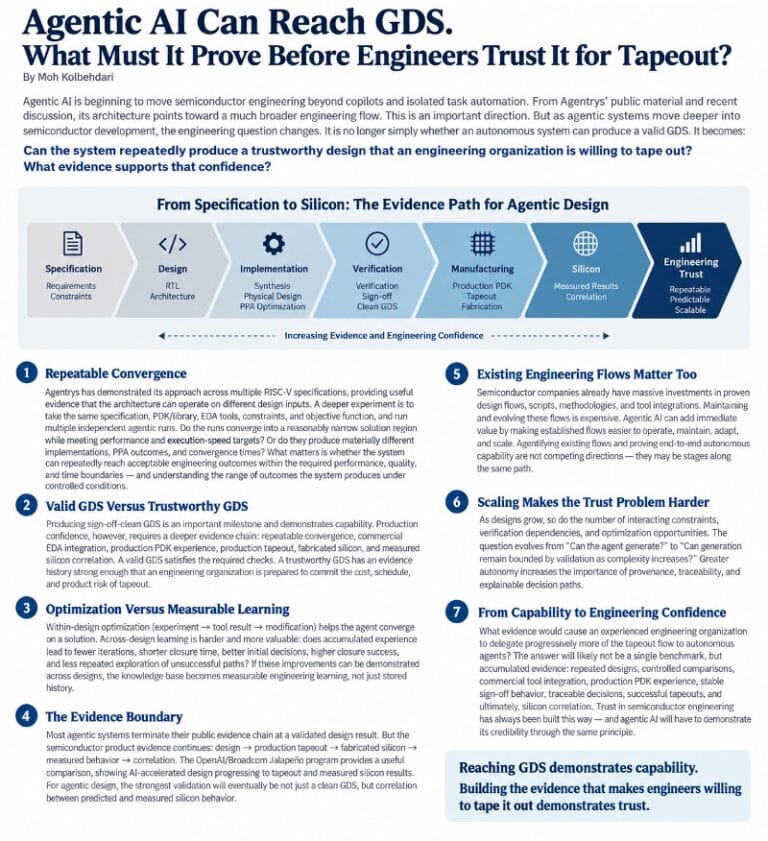
Specification → RTL → verification → synthesis / physical design → PPA optimization → physical verification → sign-off-clean GDS
에이전틱 AI(Agentic AI)는 반도체 설계를 단순한 코파일럿이나 고립된 작업 자동화의 단계를 넘어 진화시키고 있습니다. 에이전트리스(Agentrys)의 공개 자료와 최근 논의를 살펴보면, 그 아키텍처는 다음과 같은 광범위한 엔지니어링 흐름을 지향하고 있습니다.
명세(Specification) → RTL → 검증(Verification) → 합성/물리적 설계(Synthesis / Physical Design) → PPA 최적화 → 물리적 검증 → 사인오프 클린 GDS (Sign-off-clean GDS)
The platform combines hierarchical agents, bounded iteration loops, objective functions, provenance, and a knowledge base intended to feed engineering experience back into subsequent decisions. Its broader model—Onboard → Evolve → Scale—suggests a progression from automating established engineering workflows toward reusable and increasingly capable agents.
이 플랫폼은 계층형 에이전트, 유예된 반복 루프(bounded iteration loops), 목적 함수, 출처 추적(provenance), 그리고 엔지니어링 경험을 후속 의사결정에 다시 반영하기 위한 지식 베이스를 결합하고 있습니다. 온보드(Onboard) → 진화(Evolve) → 확장(Scale)으로 이어지는 거시적 모델은 기존 엔지니어링 워크플로우의 자동화에서 재사용 가능하며 점차 능력이 향상되는 에이전트로의 진전을 시사합니다.
That direction is important, but as agentic systems move deeper into semiconductor development, the engineering question changes. The issue is no longer simply whether an autonomous system can produce a valid GDS. The more consequential question is whether it can repeatedly produce a trustworthy design that an engineering organization is willing to tape out—and what evidence supports that confidence.
이러한 방향성은 중요하지만, 에이전틱 시스템이 반도체 개발의 더 깊은 영역으로 파고들수록 엔지니어링의 핵심 질문은 달라집니다. 이제 자율 시스템이 유효한 GDS를 생성할 수 있는지 여부는 더 이상 주된 쟁점이 아닙니다. 보다 중대한 질문은 엔지니어링 조직이 기꺼이 테이프아웃(Tapeout)을 감행할 수 있을 만큼 신뢰할 수 있는 설계를 반복적으로 도출할 수 있는지, 그리고 그 확신을 뒷받침하는 근거가 무엇인가 하는 점입니다.
That distinction may define the next phase of agentic semiconductor design.
이러한 구분이야말로 에이전틱 반도체 설계의 다음 단계를 규정할 수 있습니다.
Repeatable Convergence
One of the most important questions is repeatability. Agentrys has demonstrated its approach across multiple RISC-V specifications, providing useful evidence that the architecture can operate across different design inputs. A different experiment would reveal something equally important: behavioral consistency under controlled conditions.
가장 중요한 질문 중 하나는 '반복 가능성(Repeatability)'입니다. 에이전트리스는 여러 RISC-V 명세에 걸쳐 자사의 접근 방식을 입증해 보였으며, 이는 해당 아키텍처가 서로 다른 설계 입력 조건에서도 작동할 수 있음을 보여주는 유용한 증거입니다. 이와는 다른 실험을 통해 똑같이 중요한 사실을 밝혀낼 수도 있습니다. 바로 통제된 조건에서의 행동 일관성입니다.
Take exactly the same specification, PDK/library, EDA tools, constraints, and objective function, then launch multiple independent agentic runs. Compare the resulting distributions of:
- frequency
- power
- area
- floorplan and physical architecture
- sign-off results
- time to convergence
- number of iterations to closure
정확히 동일한 명세, PDK/라이브러리, EDA 툴, 제약 조건, 목적 함수를 사용해 여러 독립적인 에이전틱 실행(Run)을 구동한다고 가정해 보겠습니다. 그리고 다음과 같은 결과 분포를 비교해 보는 것입니다.
- 주파수(Frequency)
- 전력(Power)
- 면적(Area)
- 층류 계획(Floorplan) 및 물리적 아키텍처
- 사인오프 결과
- 수렴까지 소요되는 시간
- 마감(Closure)까지의 반복 횟수
Do the runs converge into a reasonably narrow solution region while meeting the required performance and execution-speed targets? Or do they produce materially different physical implementations, PPA outcomes, and convergence times while still satisfying the formal constraints?
이 실행들은 요구되는 성능 및 실행 속도 목표를 충족하는 동시에, 충분히 좁은 솔루션 영역으로 수렴할까요? 아니면 형식적인 제약 조건은 만족하더라도 실질적으로 서로 다른 물리적 구현, PPA 결과, 수렴 시간을 도출할까요?
Neither result necessarily means the system is good or bad. Semiconductor design contains large solution spaces, and different valid implementations can exist. What matters is whether the system can repeatedly reach acceptable engineering outcomes within the required performance, quality, and time boundaries.
어떤 결과가 나오든 그것이 시스템의 우열을 곧바로 의미하는 것은 아닙니다. 반도체 설계에는 거대한 솔루션 공간이 존재하며, 서로 다른 유효한 구현 방식들이 존재할 수 있기 때문입니다. 중요한 것은 해당 시스템이 요구되는 성능, 품질, 시간의 경계 내에서 수용 가능한 엔지니어링 결과에 반복적으로 도달할 수 있는지 여부입니다.
For an autonomous engineering system, repeatability does not have to mean identical layouts. It means understanding the range of outcomes the system produces under controlled conditions. That gives an engineering organization something more useful than a single successful run: a measure of behavioral consistency.
자율 엔지니어링 시스템에 있어 반복 가능성이란 반드시 동일한 레이아웃을 산출해야 함을 의미하지는 않습니다. 그것은 통제된 조건에서 시스템이 생성해 내는 결과의 범위를 이해하는 것을 뜻합니다. 이를 통해 엔지니어링 조직은 단 한 번의 성공적인 실행보다 훨씬 더 유용한 자산, 즉 '행동 일관성의 지표'를 얻을 수 있습니다.
Valid GDS Versus Trustworthy GDS
Producing sign-off-clean GDS is an important milestone. Agentrys has publicly reported an AgentCore CPU implementation using open-source tools and the ASAP7 predictive library, including reported frequency, area, and clean physical-verification results. That demonstrates capability.
사인오프를 통과한(Sign-off-clean) GDS를 산출하는 것은 중요한 이행기적 이정표입니다. 에이전트리스는 오픈소스 툴과 ASAP7 예측 라이브러리를 사용하여 AgentCore CPU 구현 사례를 공개적으로 보고한 바 있으며, 여기에는 보고된 주파수, 면적, 그리고 클린 상태의 물리적 검증 결과가 포함되어 있습니다. 이는 능력을 입증하는 대목입니다.
Production confidence, however, requires a deeper evidence chain:
repeatable convergence
↓
commercial EDA integration
↓
production PDK / advanced-node environment
↓
production tapeout
↓
fabricated silicon
↓
measured silicon correlation
그러나 생산 단계의 신뢰(Production confidence)를 확보하기 위해서는 더 깊은 검증 체인(Evidence chain)이 요구됩니다.
반복 가능한 수렴
↓
상용 EDA 통합
↓
생산용 PDK / 첨단 노드 환경
↓
생산 테이프아웃
↓
실리콘 제작
↓
측정된 실리콘 상관관계(Correlation)
Each step answers a different engineering question: can the agents operate the tools, close the design, do so repeatedly, work within production-qualified environments, and ultimately produce silicon that behaves as predicted?
각 단계는 서로 다른 엔지니어링적 질문에 답합니다. 에이전트가 툴을 조작하고, 설계를 마감하며, 이를 반복적으로 수행하고, 생산 자격을 갖춘 환경 내에서 작동하며, 궁극적으로 예측한 대로 작동하는 실리콘을 생산해 낼 수 있는가 하는 점입니다.
This is why I distinguish between a valid GDS and a trustworthy GDS. A valid GDS satisfies the required checks within the demonstrated environment. A trustworthy GDS has an evidence history strong enough that an engineering organization is prepared to commit the cost, schedule, and product risk of tapeout.
필자가 '유효한(Valid) GDS'와 '신뢰할 수 있는(Trustworthy) GDS'를 구분하는 이유가 바로 여기에 있습니다. 유효한 GDS는 입증된 환경 내에서 요구되는 검증 항목들을 충족한 것입니다. 반면 신뢰할 수 있는 GDS는 엔지니어링 조직이 테이프아웃에 따르는 비용, 일정, 제품 리스크를 감수할 만큼 충분히 강력한 증거 이력을 갖춘 것을 말합니다.
The practical question eventually becomes: what is the probability that this system repeatedly produces a design I am willing to tape out, and what evidence supports that confidence?
결국 현실적인 질문은 이것으로 귀결됩니다. "이 시스템이 내가 기꺼이 테이프아웃할 수 있는 설계를 반복적으로 생산해 낼 확률은 얼마이며, 그 확신을 뒷받침하는 증거는 무엇인가?"
Optimization Versus Measurable Learning
Agentrys’ Evolve concept raises another important issue. The company describes a continuously curated knowledge base containing design recipes, tool behavior, PPA-closure heuristics, and sign-off lessons, with completed engineering work feeding subsequent decisions.
에이전트리스의 '진화(Evolve)' 개념은 또 다른 중요한 문제를 제기합니다. 이 회사는 설계 레시피, 툴 동작, PPA 마감 휴리스틱, 사인오프 교훈 등이 포함된 지속적으로 큐레이션되는 지식 베이스를 설명하며, 완료된 엔지니어링 작업이 후속 의사결정에 피드백된다고 언급합니다.
That creates the possibility of something more significant than workflow automation. But there is an important distinction between two loops.
이는 단순한 워크플로우 자동화 그 이상의 중대한 가능성을 열어줍니다. 하지만 여기에는 두 가지 루프 간의 중요한 차이가 존재합니다.
- Within-design optimization: experiment → tool result → modification → next experiment. The agent improves its next action within a particular design trajectory.
- Across-design learning: validated experience from one design → improved decisions on subsequent designs
- 설계 내 최적화 (Within-design optimization): 실험 → 툴 결과 → 수정 → 다음 실험. 에이전트는 특정 설계 궤적 내에서 다음 동작을 개선합니다.
- 설계 간 학습 (Across-design learning): 한 설계에서 검증된 경험 → 후속 설계에서의 향상된 의사결정.
The second loop is much harder—and potentially much more valuable. A system can accumulate enormous amounts of history without demonstrating that the history improves future engineering outcomes.
두 번째 루프는 훨씬 더 어렵고 잠재적으로 훨씬 더 가치 있습니다. 시스템은 향후 엔지니어링 결과가 개선된다는 점을 입증하지 못한 채 엄청난 양의 이력을 축적하기만 할 수도 있습니다.
Transferable learning should therefore become measurable. Does accumulated experience produce:
- fewer iterations?
- shorter closure time?
- better initial decisions?
- higher closure success?
- narrower outcome distributions?
- less repeated exploration of previously unsuccessful paths?
따라서 전이 가능한 학습(Transferable learning)은 측정 가능해야 합니다. 축적된 경험이 다음과 같은 결과를 만들어내고 있을까요?
- 더 적은 반복 횟수?
- 더 짧은 마감 시간?
- 더 나은 초기 의사결정?
- 더 높은 마감 성공률?
- 더 좁은 결과 분포?
- 이전의 실패한 경로에 대한 반복적인 탐색 감소?
If those improvements can be demonstrated across designs, the knowledge base becomes more than stored history. It becomes measurable engineering learning.
만약 이러한 개선 사항이 여러 설계에 걸쳐 입증될 수 있다면, 지식 베이스는 단순한 저장된 이력을 넘어섭니다. 그것은 '측정 가능한 엔지니어링 학습'이 되는 것입니다.
The Evidence Boundary
Most EDA-oriented agentic systems naturally terminate their public evidence chain at a validated design result. That is a legitimate boundary: EDA produces the information required to manufacture the device; it does not manufacture the silicon itself.
대부분의 EDA 중심 에이전틱 시스템은 검증된 설계 결과에서 자연스럽게 공개적인 증거 체인을 마무리합니다. 이는 타당한 경계입니다. EDA는 디바이스 제조에 필요한 정보를 생성할 뿐, 실리콘 자체를 제조하지는 않기 때문입니다.
But semiconductor product evidence continues beyond GDS. The deeper loop is:
model-assisted design → production tapeout → fabricated silicon → measured behavior → correlation
그러나 반도체 제품의 증거는 GDS 이후에도 계속 이어집니다. 더 깊은 루프는 다음과 같습니다.
모델 기반 설계 → 생산 테이프아웃 → 제작된 실리콘 → 측정된 동작 → 상관관계 분석
Closing that loop matters because models, libraries, tools, constraints, and agent decisions ultimately represent predictions about a physical product.
이 루프를 완성하는 것이 중요한 이유는 모델, 라이브러리, 툴, 제약 조건, 에이전트의 결정이 궁극적으로 물리적 제품에 대한 예측을 나타내기 때문입니다.
A useful comparison is the OpenAI/Broadcom Jalapeño program. The comparison needs to be made carefully: OpenAI has not publicly claimed that Jalapeño was produced by a completely autonomous RTL-to-GDS agent. Its public description instead indicates that AI accelerated portions of the design and optimization process.
여기서 유용한 비교 대상은 OpenAI와 브로드컴(Broadcom)의 잘라페뇨(Jalapeño) 프로그램입니다. 다만 이 비교는 신중하게 이루어져야 합니다. OpenAI는 잘라페뇨가 완전 자율 RTL-to-GDS 에이전트에 의해 생산되었다고 공개적으로 주장한 바 없습니다. 그 대신 공개된 설명에 따르면 AI가 설계 및 최적화 프로세스의 일부를 가속화했다고 합니다.
But the program provides another kind of evidence: it progressed from design into manufacturing tapeout and subsequently into measured fabricated-silicon results. That creates a deeper evidence loop.
그러나 이 프로그램은 또 다른 형태의 증거를 제공합니다. 설계에서 시작해 제조 테이프아웃으로 나아갔고, 이어서 제작된 실리콘의 측정 결과로 이어졌습니다. 이는 더 깊은 증거 루프를 형성합니다.
For agentic semiconductor engineering, reaching that point will be significant. The strongest validation of an autonomous design system will eventually be not simply that its GDS passes design checks, but that its predictions correlate with the behavior of manufactured silicon.
에이전틱 반도체 엔지니어링에 있어서 그 지점에 도달하는 것은 대단히 의미 있는 일이 될 것입니다. 자율 설계 시스템에 대한 가장 강력한 검증은 단순히 GDS가 설계 검증을 통과했다는 점이 아니라, 그 예측 결과가 제조된 실리콘의 동작과 일치한다는 점이 될 것입니다.
Existing Engineering Flows Matter Too
Duo Ding raised an important point in the discussion around the original version of this article. Semiconductor companies already possess enormous investments in legacy design flows, scripts, methodologies, tool integrations, and engineering knowledge. Those flows work, but maintaining and evolving them is expensive.
두오 딩(Duo Ding)은 이 글의 원문과 관련된 논의에서 중요한 지적을 했습니다. 반도체 기업들은 이미 레거시 설계 플로우, 스크립트, 방법론, 툴 통합, 그리고 엔지니어링 지식에 막대한 투자를 해왔습니다. 이러한 플로우들은 잘 작동하고 있지만, 이를 유지하고 진화시키는 데는 큰 비용이 듭니다.
That means the near-term opportunity for agentic AI is not limited to replacing an existing semiconductor development process with an entirely autonomous one. There is substantial value in making established flows easier to operate, maintain, adapt, and scale.
이는 에이전틱 AI의 단기적 기회가 기존 반도체 개발 프로세스를 완전히 자율적인 프로세스로 대체하는 것에만 국한되지 않음을 의미합니다. 기존 플로우를 더 쉽게 운용하고, 유지보수하며, 적응시키고 확장할 수 있도록 만드는 데도 상당한 가치가 존재합니다.
This may be one of the most practical paths toward greater autonomy. An agent operating inside an existing engineering flow inherits boundaries that experienced engineers have already established. Its performance can be compared with known results, and engineers can observe where it succeeds, where intervention remains necessary, and which tasks can safely be delegated.
이것이 아마도 더 큰 자율성을 향해 나아가는 가장 현실적인 경로 중 하나일 것입니다. 기존 엔지니어링 플로우 내부에서 작동하는 에이전트는 숙련된 엔지니어들이 이미 구축해 놓은 경계(Boundary)를 이어받게 됩니다. 그 성능은 알려진 결과와 비교될 수 있으며, 엔지니어들은 에이전트가 어디서 성공하고 어디서 개입이 여전히 필요한지, 그리고 어떤 작업을 안전하게 위임할 수 있는지 관찰할 수 있습니다.
That creates evidence gradually. In that sense, agentifying existing flows and proving autonomous end-to-end capability are not competing directions. They may be stages along the same path.
이러한 과정은 점진적으로 증거를 축적합니다. 그런 의미에서 기존 플로우의 에이전트화와 자율적인 엔드투엔드(End-to-end) 역량의 입증은 서로 경쟁하는 방향이 아닙니다. 그것은 동일한 경로상의 단계들일 수 있습니다.
Scaling Makes the Trust Problem Harder
Agentrys’ Onboard → Evolve → Scale direction is logical. But scaling an autonomous semiconductor engineering system is not only an agent-scaling problem.
에이전트리스의 온보드(Onboard) → 진화(Evolve) → 확장(Scale) 방향성은 논리적입니다. 그러나 자율 반도체 엔지니어링 시스템을 확장하는 것은 단지 에이전트 스케일링의 문제만이 아닙니다.
As designs grow, so do the number of interacting constraints, possible implementation paths, verification dependencies, optimization opportunities, local optima, physical-design interactions, and the consequences of decisions made earlier in the flow.
설계가 커질수록 상호 작용하는 제약 조건, 가능한 구현 경로, 검증 종속성, 최적화 기회, 지역적 최적점(Local optima), 물리적 설계 상호 작용, 그리고 플로우 초기 단계에서 내린 결정의 파급 효과들도 함께 늘어납니다.
The question therefore evolves from whether the agent can generate to whether generation can remain bounded by validation as complexity increases—and whether validated outcomes can become reusable engineering learning without losing traceability and engineering confidence.
따라서 질문은 에이전트가 '생성'할 수 있는지의 여부에서, 복잡성이 증가함에 따라 '생성'이 검증의 테두리 안에 계속 묶여 있을 수 있는지의 여부로 진화합니다. 그리고 추적 가능성과 엔지니어링적 확신을 잃지 않으면서 검증된 결과가 재사용 가능한 엔지니어링 학습으로 전환될 수 있는지의 문제로 이어집니다.
This is where provenance becomes particularly important. If an autonomous system changes a constraint, modifies RTL, selects a physical-design strategy, reacts to a tool result, or chooses among competing PPA alternatives, engineers eventually need to understand not only the final result but the evidence trail that produced it.
이 지점에서 출처 추적(Provenance)이 특히 중요해집니다. 자율 시스템이 제약 조건을 변경하거나, RTL을 수정하거나, 물리적 설계 전략을 선택하거나, 툴 결과에 반응하거나, 경쟁하는 PPA 대안들 중에서 선택을 내릴 경우, 엔지니어들은 최종 결과뿐만 아니라 그것을 도출해 낸 증거의 추적 경로(Evidence trail)를 결국 이해해야만 합니다.
Greater autonomy increases the importance of that evidence.
자율성이 커질수록 이러한 증거의 중요성도 함께 커집니다.
From Capability to Engineering Confidence
This leads to what I think is the central question for the next phase of agentic semiconductor engineering: what evidence would cause an experienced engineering organization to delegate progressively more of the tapeout flow to autonomous agents?
이러한 흐름은 에이전틱 반도체 엔지니어링의 다음 단계를 위한 핵심 질문으로 귀결됩니다. "어떤 증거가 있어야 숙련된 엔지니어링 조직이 테이프아웃 플로우의 점진적인 부분을 자율 에이전트에 위임하게 될까요?"
The answer will probably not be one benchmark. It will be accumulated evidence:
- repeated designs
- controlled comparisons
- commercial tool integration
- production PDK experience
- stable sign-off behavior
- traceable decisions
- successful tapeouts
- eventually, silicon correlation
그 대답은 단 하나의 벤치마크가 아닐 것입니다. 그것은 다음과 같은 축적된 증거들이 될 것입니다.
- 반복된 설계 경험
- 통제된 비교 결과
- 상용 툴 통합
- 생산 PDK 경험
- 안정적인 사인오프 동작
- 추적 가능한 의사결정
- 성공적인 테이프아웃
- 궁극적으로는 실리콘 상관관계를 증명하는 일
Trust in semiconductor engineering has always been built this way. Design rules are trusted because they are validated. Models are trusted because they are correlated. Processes are trusted because they demonstrate repeatability. Sign-off flows are trusted because their relationship to manufacturing outcomes has been established over time.
반도체 엔지니어링의 신뢰는 언제나 이런 방식으로 구축되어 왔습니다. 설계 규칙은 검증되었기 때문에 신뢰받습니다. 모델은 상관관계가 입증되었기 때문에 신뢰받습니다. 공정은 반복성을 입증하기 때문에 신뢰받습니다. 사인오프 플로우는 제조 결과와의 관계가 시간에 걸쳐 확립되었기 때문에 신뢰받습니다.
Agentic AI will likely have to build its engineering credibility through the same principle.
에이전틱 AI 역시 동일한 원리를 통해 엔지니어링 신뢰성을 구축해 나가야 할 것입니다.
The webinar convinced me that agentic chip design is moving beyond isolated copilots toward long-running engineering workflows. The next major milestone should therefore not be viewed simply as another demonstration that AI can reach GDS.
이번 웨비나는 에이전틱 칩 설계가 고립된 코파일럿의 단계를 넘어 장기 실행되는 엔지니어링 워크플로우로 진입하고 있음을 확신시켜 주었습니다. 따라서 다음 주요 마일스톤은 AI가 GDS에 도달할 수 있음을 보여주는 또 다른 시연 정도로 여겨져서는 안 됩니다.
It will be evidence that autonomous engineering can converge repeatably, learn measurably, operate within trusted production flows, preserve traceability, and ultimately correlate design decisions with fabricated silicon.
그것은 자율 엔지니어링이 반복적으로 수렴하고, 측정 가능하게 학습하며, 신뢰할 수 있는 생산 플로우 내에서 작동하고, 추적 가능성을 보존하며, 최종적으로 설계 결정을 제작된 실리콘과 일치시킬 수 있음을 보여주는 증거가 될 것입니다.
Reaching GDS demonstrates capability.
GDS에 도달하는 것은 '역량'을 증명하는 것입니다.
Building the evidence that makes engineers willing to tape it out demonstrates trust.
엔지니어가 기꺼이 테이프아웃을 감행하게 만드는 '증거'를 구축하는 것은 '신뢰'를 증명하는 것입니다.