Glass Is Becoming an AI Infrastructure Platform
Source: https://semiwiki.com/3dic/375726-glass-is-becoming-an-ai-infrastructure-platform/
The value of glass will be determined not by its material properties alone, but by whether it can expand the package architecture window and be realized repeatedly at manufacturing scale.
유리의 가치는 그 소재 자체의 물성만으로 결정되지 않으며, 패키지 아키텍처의 허용 한계(window)를 확장할 수 있는지, 그리고 제조 규모에서 반복적으로 구현될 수 있는지에 의해 결정될 것입니다.
AI infrastructure is pushing advanced packaging into a regime where the substrate itself increasingly determines what can be built.
AI 인프라는 기판 자체에 의해 무엇을 구축할 수 있는지가 점점 더 좌우되는 체제로 첨단 패키징을 밀어붙이고 있습니다.
As packages grow larger, chiplets move closer together, redistribution becomes finer, power density rises, and alignment and warpage margins shrink, the substrate is no longer just a passive support structure.
패키지가 커지고, 칩렛들이 더 가까워지며, 재배선(redistribution)이 더 미세해지고, 전력 밀도가 높아지며, 정렬 및 휨(warpage) 마진이 줄어듦에 따라, 기판은 더 이상 단순한 수동적 지지 구조물이 아닙니다.
It becomes part of the architecture. And that is where glass becomes potentially transformative.
기판은 아키텍처의 일부가 됩니다. 그리고 바로 이 지점에서 유리가 잠재적으로 혁신적인 소재가 됩니다.
The Substrate Is Becoming an Architecture Constraint
The package substrate increasingly determines:
- how large the package can become,
- how closely chiplets can be placed,
- how fine the redistribution geometry can be,
- how much warpage can be tolerated,
- how stable alignment remains during processing,
- how electrical paths scale,
- and how much integration can occur before package mechanics become limiting.
패키지 기판은 점점 더 다음 요소들을 결정합니다.
- 패키지를 얼마나 크게 만들 수 있는지
- 칩렛을 얼마나 가깝게 배치할 수 있는지
- 재배선 기하학적 구조를 얼마나 미세하게 구현할 수 있는지
- 휨 현상을 얼마나 허용할 수 있는지
- 공정 중 정렬 상태가 얼마나 안정적으로 유지되는지
- 전기적 경로가 어떻게 확장되는지
- 패키지 역학이 한계에 부딪히기 전에 통합이 얼마나 이루어질 수 있는지
These are not isolated material questions. They are package-geometry and interface questions.
이것들은 고립된 소재적 질문들이 아닙니다. 이것들은 패키지 기하학 및 인터페이스에 관한 질문들입니다.
The substrate influences the physical boundaries between die, memory, interconnect, redistribution, thermal structures, board interfaces, and assembly processes.
기판은 다이, 메모리, 인터커넥트, 재배선, 열 구조물, 보드 인터페이스, 조립 공정 사이의 물리적 경계에 영향을 미칩니다.
As AI packages become larger and more heterogeneous, those boundaries become harder to control. That means the package process window increasingly becomes part of the architecture.
AI 패키지가 더 커지고 이종(heterogeneous) 결합이 심화됨에 따라, 그러한 경계들을 제어하기가 더 어려워집니다. 이는 곧 패키지 공정 허용 한계가 아키텍처의 일부가 된다는 것을 의미합니다.
Glass Could Expand the Package Process Window
This is where glass becomes interesting. Its potential value is not simply:
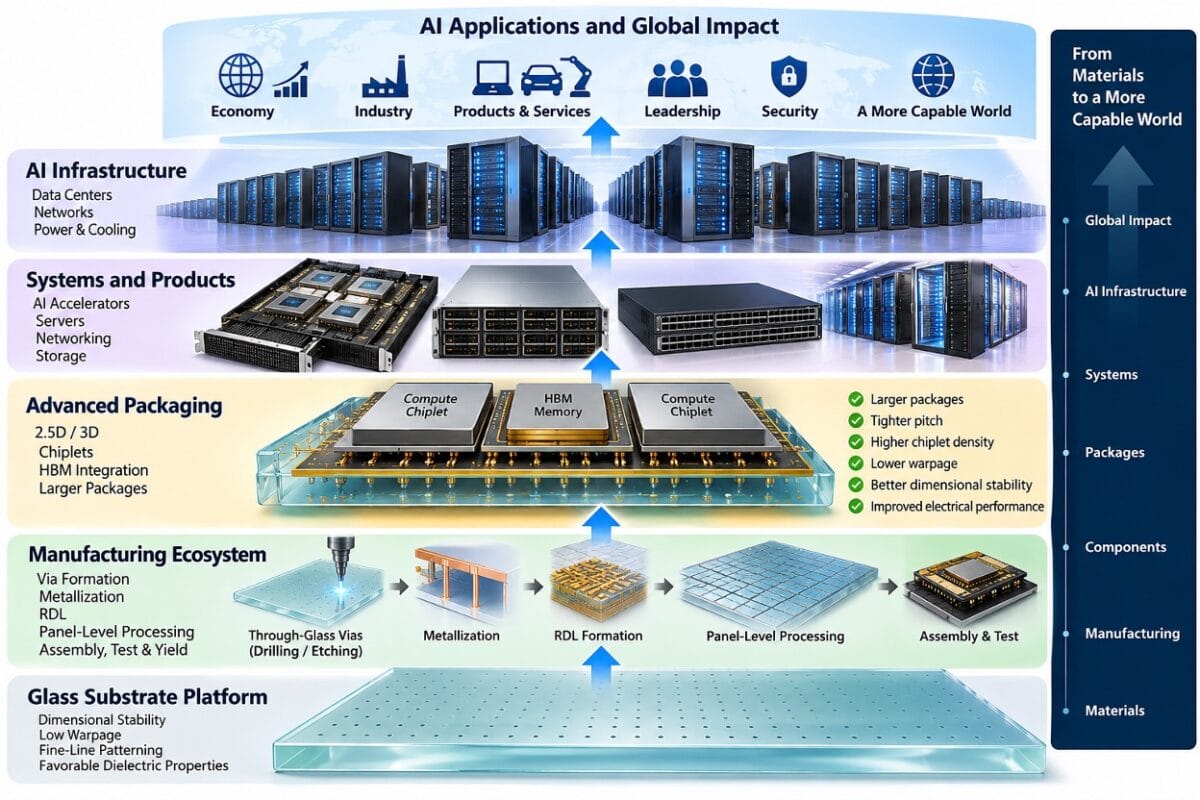
- lower warpage,
- better dimensional stability,
- fine-line capability,
- attractive dielectric behavior,
- or compatibility with large-format processing.
이 지점이 바로 유리가 흥미로워지는 이유입니다. 유리의 잠재적 가치는 단순히 다음과 같은 특성들에 국한되지 않습니다.
- 낮은 휨
- 더 나은 치수 안정성
- 미세 회선(fine-line) 구현 능력
- 매력적인 유전체 특성
- 대형 포맷 공정과의 호환성
The deeper opportunity is that these characteristics may allow the package to operate inside a wider or more stable physical process window. That can mean:
larger package size
→ tighter geometry
→ better registration
→ more stable interfaces
→ more predictable assembly
→ greater integration density
더 깊은 기회는 이러한 특성들이 패키지가 더 넓거나 안정적인 물리적 공정 허용 한계 내에서 작동하도록 허용할 수 있다는 점입니다. 이는 다음을 의미할 수 있습니다.
더 큰 패키지 크기
→ 더 미세한 기하학적 구조
→ 더 나은 정합(registration)
→ 더 안정적인 인터페이스
→ 더 예측 가능한 조립
→ 더 높은 통합 밀도
If that holds through manufacturing, glass does more than improve one property. It changes what package architectures are physically realizable. That is why glass could become an architecture-enabling platform for AI infrastructure.
이것이 제조 공정 전반에 걸쳐 유지된다면, 유리는 단순히 하나의 물성을 개선하는 그 이상의 역할을 합니다. 유리는 물리적으로 구현 가능한 패키지 아키텍처 자체를 변화시킵니다. 이것이 바로 유리가 AI 인프라를 위한 아키텍처 구현 플랫폼이 될 수 있는 이유입니다.
AI Infrastructure Demand Is Pulling Glass Forward
AI accelerators are pushing packaging in several directions at once. Compute die are getting larger and more powerful. HBM is being placed increasingly close to compute. Chiplet counts are increasing. Electrical routing density is rising. Thermal density is rising. Package dimensions are expanding. At the same time, assembly tolerances are becoming less forgiving. That creates a fundamental tension:
the package is getting larger while the acceptable geometric error is getting smaller.
AI 가속기는 여러 방향으로 패키징을 동시에 밀어붙이고 있습니다. 연산 다이(Compute die)는 점점 더 커지고 강력해지고 있습니다. HBM(고대역폭 메모리)이 연산 장치와 점점 더 가까이 배치되고 있습니다. 칩렛의 개수가 증가하고 있습니다. 전기적 라우팅 밀도가 높아지고 있습니다. 열 밀도가 높아지고 있습니다. 패키지 크기가 확장되고 있습니다. 동시에 조립 공차(tolerance)는 점점 더 용납의 여지가 없어지고 있습니다. 이는 근본적인 긴장감을 조성합니다.
허용 가능한 기하학적 오차가 줄어드는 동안 패키지는 오히려 커지고 있는 것입니다.
This is exactly the kind of problem where substrate dimensional stability becomes strategically important. Glass therefore is not being pulled forward by one application. It is being pulled by the broader physical requirements of AI infrastructure.
이것이 정확히 기판 치수 안정성이 전략적으로 중요해지는 문제입니다. 따라서 유리는 단 하나의 애플리케이션에 의해 끌려 나오는 것이 아닙니다. 유리는 AI 인프라의 광범위한 물리적 요구사항에 의해 이끌려 나오고 있습니다.
Dimensional Stability Becomes an AI Packaging Variable
Dimensional stability sounds like a material property. But in advanced packaging, it quickly becomes a system variable.
치수 안정성은 마치 소재 물성처럼 들립니다. 그러나 첨단 패키징에서는 이내 시스템 변수가 됩니다.
For example:
lower substrate deformation
→ better die-to-substrate registration
→ more stable RDL geometry
→ improved assembly alignment
→ more predictable electrical and mechanical behavior
예를 들어:
더 낮은 기판 변형
→ 더 나은 다이-기판 정합(registration)
→ 더 안정적인 RDL(재배선 층) 기하구조
→ 향상된 조립 정렬
→ 더 예측 가능한 전기적·기계적 거동
Or:
lower warpage
→ improved coplanarity
→ more consistent attach
→ lower variation in interconnect geometry
→ more stable product performance
또는:
더 낮은 휨
→ 향상된 평탄도(coplanarity)
→ 더 일관된 부착(attach)
→ 인터커넥트 기하구조의 변동성 감소
→ 더 안정적인 제품 성능
That is where material behavior becomes architecture value. The important question is not:
How stable is the glass?
바로 이 지점에서 소재의 거동이 아키텍처의 가치로 전환됩니다. 중요한 질문은 이것이 아닙니다.
"유리가 얼마나 안정적인가?"
It is:
What package constraints can that stability remove?
대신 이 질문을 던져야 합니다.
"그 안정성이 어떤 패키지 제약 조건을 제거할 수 있는가?"
That is a much more useful way to evaluate the platform.
이것이 바로 플랫폼을 평가하는 훨씬 더 유용한 방법입니다.
Glass Creates an Opportunity for the Manufacturing Industry
The opportunity is not limited to substrate suppliers. If glass scales, it creates a broader manufacturing ecosystem around:
- through-glass via formation,
- laser drilling and etching,
- metallization,
- redistribution layers,
- fine-line processing,
- panel handling,
- inspection,
- metrology,
- assembly,
- test,
- reliability,
- and qualification.
이 기회는 기판 공급업체에만 국한되지 않습니다. 유리가 대규모로 양산될 수 있다면, 다음과 같은 분야를 아우르는 더 넓은 제조 생태계가 창출됩니다.
- 유리 관통 전극(TGV) 형성
- 레이저 드릴링 및 에칭
- 금속화(metallization)
- 재배선 층(RDL)
- 미세 회선 공정
- 패널 핸들링
- 검사(inspection)
- 계측(metrology)
- 조립
- 테스트
- 신뢰성 평가
- 퀄리피케이션(qualification)
That means glass can create new value across the packaging supply chain.
이는 유리가 패키징 공급망 전반에 걸쳐 새로운 가치를 창출할 수 있음을 의미합니다.
But it also creates new manufacturing challenges. Glass must be handled differently. Via formation has to remain uniform. Metallization has to remain reliable. Large panels must maintain dimensional control. Defects have to be detected. Interfaces have to remain stable. Assembly flows have to account for the mechanical behavior of the complete stack.
그러나 동시에 새로운 제조상의 과제들도 만들어냅니다. 유리는 다르게 다뤄져야 합니다. 비아(via) 형성은 균일하게 유지되어야 합니다. 금속화는 신뢰할 수 있어야 합니다. 대형 패널은 치수 제어력을 유지해야 합니다. 결함은 감지되어야 합니다. 인터페이스는 안정적으로 유지되어야 합니다. 조립 공정은 전체 스택의 기계적 거동을 고려해야 합니다.
So the manufacturing question becomes:
Can the industry control the complete process window, not just demonstrate the material?
따라서 제조상의 핵심 질문은 다음과 같이 바뀝니다.
"산업계가 단순히 소재를 시연해 보이는 것을 넘어, 전체 공정 허용 한계를 제어할 수 있는가?"
That is where the platform either becomes real or remains experimental.
바로 이 지점에서 플랫폼이 실체가 되거나 혹은 실험 단계에 머무르게 됩니다.
Panel-Level Processing Could Change the Economics
One of the most interesting opportunities is panel-level processing. If glass can support large-format processing while maintaining dimensional stability, it may allow the industry to change the relationship between:
- package size,
- precision,
- throughput,
- and manufacturing cost.
가장 흥미로운 기회 중 하나는 패널 레벨 공정(Panel-Level Processing)입니다. 유리가 치수 안정성을 유지하면서 대형 포맷 공정을 지원할 수 있다면, 산업계는 다음 요소들 간의 관계를 재정립할 수 있게 됩니다.
- 패키지 크기
- 정밀도
- 처리량(throughput)
- 제조 비용
That could become particularly important as AI packages continue to grow physically. The value would not be simply “bigger panels.” It would be:
larger-format manufacturing without losing the geometric control required by advanced heterogeneous integration.
이는 AI 패키지가 물리적으로 계속 성장함에 따라 특히 중요해질 수 있습니다. 그 가치는 단순히 "더 큰 패널"을 얻는 데 그치지 않을 것입니다. 그것은 다음과 같습니다.
첨단 이종 통합이 요구하는 기하학적 제어력을 잃지 않으면서 더 큰 포맷으로 제조하는 것.
That is a potentially important economic and manufacturing transition.
이것이 바로 잠재적으로 중요한 경제적·제조적 전환점입니다.
Glass Has to Prove Itself Across the Complete Package
This is where the real test begins. Glass does not operate alone. It has to coexist with:
- silicon,
- HBM,
- copper,
- RDL,
- solder,
- underfill,
- adhesives,
- thermal materials,
- organic build-up layers,
- connectors,
- and board-level assembly.
진짜 시험대는 바로 여기에서 시작됩니다. 유리는 혼자 작동하지 않습니다. 유리는 다음과 같은 요소들과 공존해야 합니다.
- 실리콘
- HBM
- 구리
- RDL
- 솔더(solder)
- 언더필(underfill)
- 접착제
- 열 인터페이스 소재
- 유기 빌드업 층
- 커넥터
- 보드 레벨 조립
Every interface matters. Glass may reduce substrate warpage but still create integration challenges elsewhere. Its dimensional stability may be excellent, but metallization or via reliability may become limiting. Its dielectric behavior may be attractive, but assembly interfaces must still survive thermal cycling. Its large-format processing may look promising, but panel handling and defect control must support yield.
모든 인터페이스가 중요합니다. 유리가 기판의 휨을 줄여줄 수 있더라도 다른 곳에서는 통합의 어려움을 유발할 수 있습니다. 유리의 치수 안정성은 훌륭할지라도 금속화나 비아의 신뢰성이 한계 요인이 될 수 있습니다. 유전체 특성은 매력적일지라도 조립 인터페이스는 여전히 열충격을 견뎌내야 합니다. 대형 포맷 공정은 유망해 보일 수 있으나 패널 핸들링과 결함 제어가 수율(yield)을 뒷받침해야 합니다.
So the real challenge is not just material compatibility. It is package coexistence and operability. The question becomes:
Can glass remain beneficial after every interface, process step, thermal cycle, and assembly operation required to build the final AI package?
따라서 진정한 과제는 단순한 소재 호환성이 아닙니다. 그것은 패키지의 공존성과 가동성입니다. 질문은 다음과 같이 귀결됩니다.
"최종 AI 패키지를 구축하는 데 필요한 모든 인터페이스, 공정 단계, 열충격 주기, 조립 작업 이후에도 유리는 유익한 상태를 유지할 수 있는가?"
That is the level at which the platform must be judged.
이것이 바로 플랫폼이 평가되어야 하는 기준선입니다.
From Material Potential to Manufacturing Reality
The maturity path matters:
R&D / Prototype
→ Pilot Production
→ Engineering Builds
→ Qualification
→ Early Commercial Production
→ High-Volume Manufacturing
성숙의 경로가 중요합니다.
R&D / 프로토타입
→ 파일럿 생산
→ 엔지니어링 빌드
→ 퀄리피케이션
→ 초기 상용 생산
→ 대량 양산(High-Volume Manufacturing)
Each stage proves something different. A prototype proves the architecture can exist. Pilot production begins to expose process variation. Engineering builds begin to reveal repeatability. Qualification tests whether the integrated structure survives expected stress. Early production exposes yield behavior. High-volume manufacturing proves the complete ecosystem can operate repeatedly and economically. This is where glass has to make the transition from:
material capability
to:
package capability
and then to:
manufacturing capability
각 단계는 서로 다른 것을 증명합니다. 프로토타입은 아키텍처가 존재할 수 있음을 증명합니다. 파일럿 생산은 공정 편차를 드러내기 시작합니다. 엔지니어링 빌드는 반복 가능성(repeatability)을 드러내기 시작합니다. 퀄리피케이션은 통합된 구조물이 예상되는 스트레스를 견뎌내는지 테스트합니다. 초기 생산은 수율 거동을 드러냅니다. 대량 양산은 전체 생태계가 반복적이고 경제적으로 운영될 수 있음을 증명합니다. 이것이 바로 유리가 다음 단계로 전환해야 하는 과정입니다.
소재의 역량
→ 패키지 역량
→ 그리고 제조 역량
The Real Test of Glass
The real test is not whether glass can demonstrate impressive material properties. It is whether glass can be realized as part of an AI infrastructure platform. That means answering harder questions:
- Can the package remain dimensionally stable at larger scale?
- Can fine-line geometries remain controlled across production?
- Can through-glass vias and metallization maintain reliability?
- Can assembly interfaces remain within tolerance?
- Can glass coexist with silicon, copper, organics, adhesives, and thermal materials?
- Can inspection and metrology identify the defects that matter?
- Can qualification demonstrate stable behavior?
- Can yield and cost support volume production?
- And most importantly, can glass enable package architectures that would otherwise be difficult to realize?
진정한 시험대는 유리가 인상적인 물성을 시연할 수 있는지 여부가 아닙니다. 그것은 유리가 AI 인프라 플랫폼의 일부로서 구현될 수 있는지 여부입니다. 이는 더 어려운 질문들에 답해야 함을 의미합니다.
- 패키지가 더 큰 규모에서도 치수 안정성을 유지할 수 있는가?
- 미세 회선 기하구조가 생산 전반에 걸쳐 제어될 수 있는가?
- 유리 관통 전극(TGV)과 금속화가 신뢰성을 유지할 수 있는가?
- 조립 인터페이스가 공차 내에 머물 수 있는가?
- 유리가 실리콘, 구리, 유기물질, 접착제, 열 관리 소재들과 공존할 수 있는가?
- 검사 및 계측이 중요한 결함을 식별해낼 수 있는가?
- 퀄리피케이션이 안정적인 거동을 증명할 수 있는가?
- 수율과 비용이 볼륨 생산을 뒷받침할 수 있는가?
- 그리고 가장 중요하게도, 유리가 그렇지 않으면 구현하기 어려운 패키지 아키텍처를 가능하게 할 수 있는가?
If the answer becomes yes, then glass has moved beyond being a substrate material. It has become part of the AI infrastructure platform. The transition is:
material capability
→ package process window
→ package architecture window
→ manufacturing capability
→ AI infrastructure capability
만약 이 질문들에 대한 답이 '그렇다'가 된다면, 유리는 단순히 기판 소재라는 범위를 넘어서게 됩니다. 유리는 AI 인프라 플랫폼의 일부가 되는 것입니다. 그 전환의 흐름은 다음과 같습니다.
소재 역량
→ 패키지 공정 허용 한계
→ 패키지 아키텍처 허용 한계
→ 제조 역량
→ AI 인프라 역량
That is the real opportunity.
이것이 바로 진정한 기회입니다.