AI-EDA Agents Can Prove Their Value
Source: https://semiwiki.com/eda/374287-ai-eda-agents-can-prove-their-value/
Before EDA becomes AI-native, focused agents have a window to prove measurable engineering value inside existing design flows.
EDA(전자 설계 자동화)가 근본적으로 AI 네이티브(AI-native)한 구조로 완전히 전환되기 전까지, 특정 영역에 집중된 에이전트들은 기존 설계 워크플로 안에서 측정 가능한 엔지니어링적 가치를 입증할 수 있는 소중한 기회의 창을 맞이하고 있습니다.
AI is entering semiconductor engineering from several directions at once. Some companies are building broad agentic design environments. Others are attacking specific bottlenecks: timing closure, verification, debug, root-cause analysis, PPA optimization, and physical implementation. That focused approach may be especially important.
인공지능은 여러 방향에서 동시에 반도체 엔지니어링 영역으로 진입하고 있습니다. 어떤 기업들은 광범위한 에이전트 기반 설계 환경을 구축하는 반면, 또 다른 기업들은 타이밍 클로저(timing closure), 검증(verification), 디버그, 근본 원인 분석, PPA(전력·성능·면적) 최적화, 그리고 물리적 구현과 같은 특정한 병목 현상을 직접 겨냥하고 있습니다. 이처럼 집중적인 접근 방식은 특히 중요할 수 있습니다.
A startup does not need to replace the EDA stack to create value. It can enter one expensive engineering loop, shorten that loop, and work around the tools engineers already trust. ChipAgents offers a useful example. Its recent timing-closure work focuses on a familiar problem: the design change itself may be quick, but discovering the real impact through synthesis, STA, and PPA analysis can take much longer. The opportunity for AI is therefore not simply to make another design change. It is to reduce the cost of the feedback loop around that change.
스타트업이 기존의 EDA 스택 전체를 대체할 필요는 없습니다. 그저 비용이 많이 드는 엔지니어링 루프 중 하나에 진입해 그 주기를 단축하고, 엔지니어들이 이미 신뢰하고 있는 기존 도구들과 연계하여 우회로를 만들어낼 수 있습니다. 칩에이전츠(ChipAgents)가 좋은 사례를 제공합니다. 최근의 타이밍 클로저 작업은 우리에게 익숙한 문제를 겨냥하고 있습니다. 설계 변경 자체는 순식간에 이루어질 수 있지만, 합성(synthesis), 정적 타이밍 분석(STA), PPA 분석을 통해 실제 영향을 파악하는 과정은 훨씬 더 오랜 시간이 걸릴 수 있습니다. 따라서 AI가 파고들 수 있는 기회는 단순히 또 다른 설계 변경안을 만들어내는 것이 아니라, 그 변경을 둘러싼 피드백 루프의 비용(시간과 자원)을 줄이는 것입니다.
From Agent to Engineering Loop
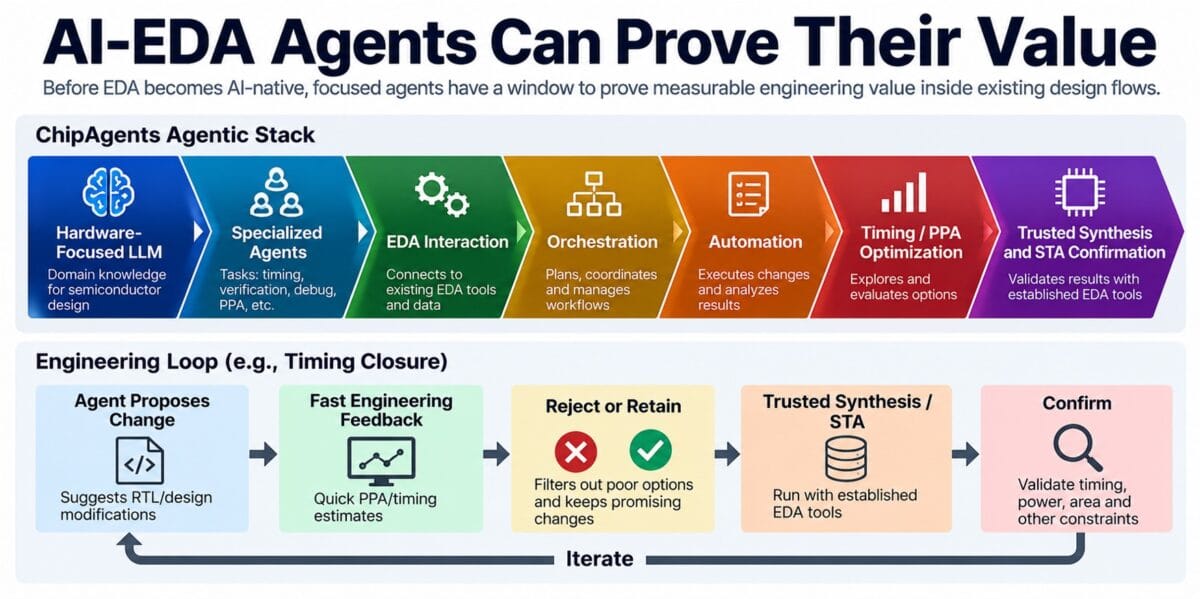
For timing closure, the practical loop can be expressed simply:
agent proposes change
→ fast engineering feedback
→ reject or retain
→ trusted synthesis / STA
→ confirm
→ iterate
타이밍 클로저(timing closure)를 위한 실무적 루프는 다음과 같이 간단하게 표현할 수 있습니다:
에이전트가 변경안 제안
→ 빠른 엔지니어링 피드백
→ 기각 또는 유지
→ 신뢰할 수 있는 합성(synthesis) / STA(정적 타이밍 분석)
→ 확인
→ 반복
That is a very practical use of AI. The agent does not have to replace synthesis. It does not have to replace STA. It does not have to become the sign-off authority. It has to help the engineering team make better decisions before every expensive full-tool iteration. ChipAgents places that loop inside a broader agentic stack that can be viewed as:
hardware-focused LLM
→ specialized agents
→ EDA interaction
→ orchestration
→ automation
→ timing / PPA optimization
→ trusted synthesis and STA confirmation
이는 AI의 매우 실용적인 활용법입니다. 에이전트가 합성을 대체할 필요는 없습니다. STA를 대체할 필요도 없습니다. 최종 승인 권한(sign-off authority)을 가질 필요도 없습니다. 비용이 많이 드는 전체 도구 반복(full-tool iteration)을 거치기 전에, 엔지니어링 팀이 더 나은 결정을 내리도록 돕는 역할이면 충분합니다. 칩에이전츠(ChipAgents)는 이러한 루프를 다음과 같이 더 넓은 에이전트 스택 내부에 위치시킵니다:
하드웨어 중심 LLM
→ 특화된 에이전트들
→ EDA 상호작용
→ 오케스트레이션
→ 자동화
→ 타이밍 / PPA 최적화
→ 신뢰할 수 있는 합성 및 STA 확인
The important point is not how many layers exist. It is whether those layers actually shorten the engineering loop while remaining correlated with the trusted tools underneath.
여기서 중요한 점은 레이어가 몇 개나 존재하는지가 아닙니다. 그 레이어들이 하부의 신뢰할 수 있는 기존 도구들과 긴밀히 연동(correlated)된 상태에서, 실제로 엔지니어링 루프를 얼마나 단축해 주느냐 하는 점입니다.
Start With the Bottleneck, Not the Entire Flow
Semiconductor design contains many expensive feedback loops. Timing closure is one. Verification triage is another. Debug is another. Coverage closure, root-cause analysis, PPA optimization, and implementation refinement all contain repeated cycles of:
analyze → decide → modify → rerun → inspect → repeat
반도체 설계 과정에는 비용이 많이 드는 수많은 피드백 루프가 존재합니다. 타이밍 클로저(Timing Closure)가 그 하나이며, 검증 트리아지(Verification Triage), 디버그(Debug) 역시 마찬가지입니다. 커버리지 클로저(Coverage Closure), 근본 원인 분석(Root-cause Analysis), PPA(전력·성능·면적) 최적화, 그리고 구현 고도화(Implementation Refinement) 모두 다음과 같은 반복적인 주기를 담고 있습니다.
분석 → 결정 → 수정 → 재실행 → 검사 → 반복
That is where focused AI agents may first create commercial value. Instead of asking whether an AI system can design an entire chip autonomously, a customer can ask much simpler questions:
Did it reduce iterations?
Did it find the root cause faster?
Did it improve timing?
Did it preserve power and area?
Did the result survive trusted analysis?
Did engineering time decrease?
바로 이 지점이 집중된 AI 에이전트들이 상업적 가치를 가장 먼저 창출할 수 있는 영역입니다. AI 시스템이 전체 칩을 자율적으로 설계할 수 있는지 묻는 대신, 고객들은 훨씬 더 단순하고 명확한 질문을 던질 수 있습니다.
반복 횟수가 줄어들었는가?
근본 원인을 더 빨리 찾아냈는가?
타이밍이 개선되었는가?
전력과 면적이 잘 유지되었는가?
그 결과가 신뢰할 수 있는 분석(trusted analysis)을 통과했는가?
엔지니어링 소요 시간이 감소했는가?
Those are much easier to measure. And that may be how agentic EDA enters production:
one expensive engineering loop at a time.
이러한 질문들은 훨씬 측정하기가 쉽습니다. 그리고 이것이 바로 에이전트 기반 EDA(전자 설계 자동화)가 실제 프로덕션 환경에 진입하는 방식일 수 있습니다.
비용이 많이 드는 엔지니어링 루프를 하나씩 차례대로 정복해 나가는 것입니다.
Fast Feedback Changes the Economics of Iteration
The value of fast feedback is not necessarily that AI discovers something a human engineer could never discover. It may be that the agent can evaluate more possibilities before invoking the expensive outer loop. That changes the economics.
빠른 피드백의 진정한 가치는 인간 엔지니어라면 절대 찾아내지 못할 무언가를 AI가 마법처럼 발견해 낸다는 데에만 있지 않습니다. 핵심은 비용이 많이 드는 바깥쪽 루프(full synthesis/STA 등)를 실행하기 전에 에이전트가 훨씬 더 많은 가능성을 미리 검토하고 걸러낼 수 있다는 점이며, 이것이 바로 엔지니어링의 경제학을 완전히 바꿉니다.
If the agent can reject poor choices early, keep promising ones, and reduce the number of full synthesis or STA runs, the engineering team gains time. That time matters. In advanced semiconductor development, the cost of a design decision is often not the edit itself. The cost is the delay required to discover whether the edit was actually useful. Focused AI can attack that delay directly.
에이전트가 형편없는 선택지들을 조기에 기각하고 가능성 있는 대안들만 남겨둠으로써 전체 합성이나 STA 실행 횟수를 줄여준다면, 엔지니어링 팀은 소중한 '시간'을 벌 수 있습니다. 첨단 반도체 개발 과정에서 설계 결정의 진짜 비용은 코드나 레이아웃을 수정하는 행위 그 자체에 있지 않은 경우가 많습니다. 진짜 비용은 그 수정 사항이 실제로 유용한지 확인하기 위해 기다려야 하는 지연 시간(delay)에서 발생합니다. 집중된 AI는 바로 이 지연 시간을 정조준하여 직접적으로 단축할 수 있습니다.
The Hard Question Is Repeatability
A successful demonstration proves capability. It does not prove a scalable product. The harder questions begin when the workflow moves beyond one selected example.
- How many different designs have been evaluated?
- How many starting points?
- How many architectures?
- How many process technologies and libraries?
- How stable is the correlation between the fast estimate and the trusted EDA result?
- Does the flow still converge when timing, power, and area conflict?
- How often does the engineer need to intervene?
성공적인 시연은 기술적 역량을 증명할 뿐, 확장 가능한 제품(scalable product)임을 증명하지는 못합니다. 워크플로가 단 하나의 선별된 예시를 넘어설 때, 비로소 훨씬 더 까다로운 질문들이 시작됩니다.
- 얼마나 다양한 설계안이 평가되었는가?
- 출발점은 몇 가지나 되는가?
- 아키텍처는 얼마나 다양하게 다루어지는가?
- 얼마나 다양한 공정 기술과 라이브러리가 적용되는가?
- 빠른 추정치와 신뢰할 수 있는 EDA 결과 사이의 상관관계는 얼마나 안정적인가?
- 타이밍, 전력, 면적(PPA)이 서로 상충할 때에도 플로우가 안정적으로 수렴하는가?
- 엔지니어가 개입해야 하는 빈도는 얼마나 되는가?
That is the real challenge. The test is not whether one agent improves one design. The test is whether the method produces repeatable convergence across different designs and conditions.
이것이 바로 진정한 과제입니다. 테스트의 기준은 "단 하나의 에이전트가 하나의 설계를 개선할 수 있는가"가 아닙니다. "이 방법론이 다양한 설계와 조건 속에서도 일관되고 반복 가능한 수렴을 만들어내는가" 하는 점입니다.
That distinction is critical. A startup can show an impressive demo very quickly. Building an engineering method that behaves consistently across real products is much harder.
그 구분이 매우 중요합니다. 스타트업이라면 아주 빠른 시일 내에 인상적인 데모를 보여줄 수 있습니다. 하지만 실제 제품 전반에서 일관되게 작동하는 견고한 엔지니어링 방법론을 구축하는 것은 그보다 훨씬 더 어려운 일입니다.
Correlation Matters More Than Activity
Agentic systems can generate a lot of activity.
- More iterations.
- More analyses.
- More suggestions.
- More automation.
에이전트 시스템은 엄청난 양의 작업과 활동을 만들어낼 수 있습니다.
- 더 많은 반복 작업
- 더 많은 분석
- 더 많은 제안
- 더 빠른 자동화
But activity is not the same as engineering value. If a fast timing or PPA estimate says a change is good, the next question is whether trusted synthesis and STA agree. That creates a very important measure:
How closely does the fast AI feedback predict the downstream engineering result?
하지만 '활동량'이 곧 '엔지니어링적 가치'를 의미하는 것은 아닙니다. 빠른 타이밍이나 PPA(전력·성능·면적) 추정치가 어떤 변경 사항을 '좋음'으로 평가했다 하더라도, 그 다음 핵심 질문은 "신뢰할 수 있는 실제 합성(synthesis)과 STA(정적 타이밍 분석) 결과도 그에 동의하는가" 하는 점입니다. 여기서 매우 중요한 평가 기준이 도출됩니다:
빠른 AI 피드백이 후속 엔지니어링 결과(실제 검증 결과)를 얼마나 긴밀하고 정확하게 예측하는가?
If the correlation is strong and stable, the agent becomes increasingly useful. If the correlation changes sharply by design, block, corner, or starting point, then the workflow becomes harder to trust. This is where AI-EDA begins to move from demonstration toward engineering infrastructure.
만약 그 상관관계가 강력하고 안정적이라면, 해당 에이전트의 유용성은 시간이 갈수록 급격히 높아집니다. 반대로 설계 대상, 블록, 공정 코너, 혹은 초기 출발점에 따라 상관관계가 들쑥날쑥하게 변한다면, 그 워크플로를 신뢰하기는 점점 어려워질 것입니다. 바로 이 지점이 AI-EDA(인공지능 전자 설계 자동화)가 단순한 '기술 시연(demonstration)' 단계에서 벗어나 진정한 '핵심 엔지니어링 인프라(engineering infrastructure)'로 도약하는 분기점이 됩니다.
The Large EDA Companies Have a Structural Advantage
The startup opportunity is real. But so is the incumbent advantage. The large EDA companies already own major parts of the engineering environment:
- implementation
- verification
- simulation
- timing analysis
- physical design
- sign-off
- IP
- design databases
- customer workflows
스타트업의 기회는 분명 실제적이고 명확합니다. 하지만 기존 선두 주자들(Incumbent)이 가진 거대한 우위 역시 만만치 않습니다. 거대 EDA(전자 설계 자동화) 기업들은 이미 엔지니어링 환경의 핵심 영역들을 탄탄하게 장악하고 있습니다.
- 구현(Implementation)
- 검증(Verification)
- 시뮬레이션(Simulation)
- 타이밍 분석(Timing Analysis)
- 물리적 설계(Physical Design)
- 최종 승인(Sign-off)
- IP (지식 재산)
- 설계 데이터베이스(Design Databases)
- 고객 워크플로(Customer Workflows)
They also have long-standing foundry relationships and deep customer integration. As AI becomes more deeply embedded in semiconductor design, that position matters. An incumbent can eventually place AI directly beside the underlying engines that generate the engineering data.
또한 이들은 파운드리와의 오랜 협력 관계 및 깊은 고객 통합 수준을 자랑합니다. AI가 반도체 설계에 더욱 깊숙이 자리 잡을수록 이러한 입지는 엄청난 힘을 발휘합니다. 기존 선두 주자들은 결국 핵심 엔지니어링 데이터를 생성하는 원천 엔진 바로 옆에 AI를 직접 탑재할 수 있기 때문입니다.
That means a standalone startup has to answer a difficult strategic question:
Why should an engineering team add another platform if similar intelligence becomes native to the tools it already uses?
이러한 현실은 독립형 스타트업들에게 매우 까다롭고 전략적인 질문을 던집니다.
"이미 자신이 사용하고 있는 기존 도구들에 유사한 지능(AI)이 기본 기능으로 내장된다면, 엔지니어링 팀이 왜 굳이 또 다른 별도의 플랫폼을 추가해야 하는가?"
This is why the timing of the market matters.
바로 이 지점이 시장에서의 타이밍과 진입 전략이 왜 그토록 중요한지를 보여주는 핵심 이유입니다.
The Startup Window Exists Before EDA Becomes AI-Native
Focused AI-EDA startups have a window. They can move faster. They can attack narrow pain points. They can experiment aggressively. They can build workflows around specific bottlenecks without waiting for an entire EDA platform to change.
집중형 AI-EDA 스타트업들에게는 기회의 창이 열려 있습니다. 이들은 더 빠르게 움직일 수 있고, 좁고 뾰족한 병목 구간을 공략할 수 있으며, 공격적으로 실험할 수 있습니다. 전체 EDA 플랫폼이 바뀔 때까지 기다리지 않고, 특정 병목 현상을 중심으로 워크플로를 구축할 수 있습니다.
That gives them an opportunity to establish measurable value before the same capabilities become standard features of larger platforms. The startup window therefore exists here:
prove meaningful engineering value before EDA itself becomes AI-native.
이는 대형 플랫폼들이 동일한 기능을 표준 기능으로 탑재하기 전에 스타트업들이 측정 가능한 가치를 확립할 수 있는 기회를 제공합니다. 따라서 스타트업의 기회의 창은 바로 여기에 존재합니다:
EDA 자체가 AI 네이티브가 되기 전에 의미 있는 엔지니어링 가치를 증명하는 것입니다.
That value has to be visible. Not just more automation. Not just more agents. Not just a better demo. It has to show up as:
- fewer expensive iterations
- faster convergence
- better root-cause identification
- stronger PPA tradeoffs
- lower engineering effort
- repeatable results
- trusted-tool agreement
그 가치는 눈에 보여야 합니다. 단순한 자동화 증가나 에이전트의 확충, 또는 더 나은 데모 수준에 그쳐서는 안 됩니다. 다음과 같은 형태로 나타나야 합니다:
- 비용이 많이 드는 반복 작업의 감소
- 더 빠른 수렴
- 향상된 근본 원인 파악
- 더 강력한 PPA(전력·성능·면적) 트레이드오프
- 엔지니어링 투입 노력 감소
- 반복 가능한 결과
- 신뢰할 수 있는 도구와의 일치
If a startup can prove those things, it becomes harder to dismiss.
스타트업이 이러한 점들을 증명할 수 있다면, 쉽게 무시할 수 없는 존재가 됩니다.
Startups Have Speed. Incumbents Have Infrastructure.
That creates an interesting competitive dynamic. Startups have:
- speed
- focus
- specialization
- freedom to experiment
이는 흥미로운 경쟁 구도를 만들어냅니다. 스타트업이 가진 강점은 다음과 같습니다:
- 속도
- 집중력
- 특화성
- 실험의 자유
Large EDA companies have:
- installed workflows
- trusted sign-off
- customer relationships
- design data
- foundry integration
- platform scale
대형 EDA 기업이 가진 강점은 다음과 같습니다:
- 설치된 워크플로
- 신뢰받는 최종 승인(sign-off)
- 고객과의 관계
- 설계 데이터
- 파운드리 통합
- 플랫폼 규모
Neither advantage is trivial. The startup does not need to beat the incumbent everywhere. It only needs to become important enough in one or more workflows that the capability becomes strategic. That can lead to several outcomes. The startup may become a broader platform. It may remain an independent specialized layer. It may become a partner. Or it may become strategically attractive to a larger EDA company.
어느 쪽의 우위도 결코 가볍지 않습니다. 스타트업이 모든 곳에서 기존 선두 주자를 이길 필요는 없습니다. 단지 하나 이상의 워크플로에서 그 역량이 전략적으로 중요해질 만큼 충분히 중요해지면 됩니다. 이는 여러 가지 결과로 이어질 수 있습니다. 스타트업은 더 광범위한 플랫폼으로 성장할 수도 있고, 독립된 특화 레이어로 남을 수도 있습니다. 파트너가 될 수도 있으며, 대형 EDA 기업에게 전략적으로 매력적인 인수 대상이 될 수도 있습니다.
Integration May Matter More Than Autonomy
The companies that create the most value may not necessarily be the ones claiming the highest degree of autonomy. They may be the ones that integrate most naturally with existing engineering flows. That is an important distinction. The first commercial objective may not be:
replace the EDA stack.
가장 많은 가치를 창출하는 기업이 반드시 가장 높은 수준의 자율성을 주장하는 곳은 아닐 수 있습니다. 오히려 기존 엔지니어링 워크플로와 가장 자연스럽게 통합되는 기업일 수 있습니다. 이는 매우 중요한 차이점입니다. 초기 상업적 목표는 다음과 같지 않을 수 있습니다:
EDA 스택을 대체하는 것.
It may be:
make the EDA stack dramatically easier, faster, and more intelligent to use.
대신 다음과 같을 수 있습니다:
EDA 스택을 사용하기 훨씬 더 쉽고, 빠르며, 지능적으로 만드는 것.
That is a much more practical path to adoption. It also lowers the trust barrier because established tools can remain the final engineering reference. The AI becomes an acceleration layer. The trusted EDA environment remains the arbiter.
이는 채택을 위한 훨씬 더 현실적인 경로입니다. 또한 기존 도구들이 최종 엔지니어링 기준(레퍼런스)으로 남을 수 있기 때문에 신뢰 장벽을 낮춰줍니다. AI는 가속화 레이어가 되고, 신뢰할 수 있는 기존 EDA 환경은 최종 판정관으로 남게 됩니다.
What Should Customers Measure?
The evaluation of a focused AI-EDA agent should go beyond a demonstration. I would want to understand:
- Accuracy: Does the fast AI estimate agree with the trusted result?
- Repeatability: Does the workflow behave consistently across repeated runs?
- Convergence: Does it reliably move toward the engineering objective?
- Breadth: Does it work across different designs and conditions?
- Tradeoff control: Can it improve one objective without silently damaging another?
- Human intervention: When does the engineer need to step in?
- Integration: How naturally does it fit into the existing flow?
- Productivity: Does it reduce engineering time or expensive tool iterations?
집중형 AI-EDA 에이전트에 대한 평가는 단순한 시연(데모) 그 이상으로 나아와야 합니다. 다음 사항들을 파악하고 싶습니다:
- 정확성: 빠른 AI 추정치가 신뢰할 수 있는 결과와 일치하는가?
- 반복성: 반복 실행 시 워크플로가 일관되게 작동하는가?
- 수렴성: 엔지니어링 목표를 향해 안정적으로 수렴하는가?
- 범용성: 다양한 설계와 조건 전반에서 작동하는가?
- 트레이드오프 제어: 다른 지표를 모르게 훼손하지 않으면서 하나의 목표를 개선할 수 있는가?
- 인간의 개입: 엔지니어가 언제 개입해야 하는가?
- 통합성: 기존 워크플로에 얼마나 자연스럽게 녹아드는가?
- 생산성: 엔지니어링 소요 시간이나 비용이 많이 드는 도구 반복 횟수를 줄여주는가?
Those questions matter more than simply asking how many agents are in the system.
이러한 질문들은 시스템에 에이전트가 몇 개나 있는지 묻는 것보다 훨씬 더 중요합니다.
The Real Competitive Test
The AI-EDA market may therefore develop in two phases. First, specialized startups prove value inside narrow engineering loops. Then larger platforms absorb, reproduce, partner with, or acquire the capabilities that prove important. Competition between those two forces is healthy. The startups push the industry faster. The incumbents can eventually scale the capability across much larger engineering environments.
따라서 AI-EDA 시장은 두 단계로 발전할 수 있습니다. 먼저, 특화된 스타트업들이 좁은 엔지니어링 루프 안에서 가치를 증명합니다. 이어서 더 큰 플랫폼들이 중요성이 입증된 역량을 흡수하고, 재현하고, 파트너십을 맺거나 인수합니다. 이 두 세력 간의 경쟁은 건전한 것입니다. 스타트업들은 산업을 더 빠르게 앞으로 밀어붙입니다. 기존 선두 주자들은 결국 훨씬 더 거대한 엔지니어링 환경 전반에 걸쳐 그 역량을 확장할 수 있습니다.
The strategic question is therefore not whether AI will enter EDA. That is already happening. The more interesting question is:
Can focused AI-EDA agents prove enough repeatable engineering value to become indispensable before that intelligence becomes native to the established EDA stack?
따라서 전략적인 질문은 AI가 EDA에 진입할 것인지의 여부가 아닙니다. 그것은 이미 벌어지고 있는 일이기 때문입니다. 더 흥미로운 질문은 이것입니다:
집중형 AI-EDA 에이전트들이 그러한 지능이 기존 EDA 스택의 기본(네이티브) 기능으로 자리 잡기 전에, 없어서는 안 될 존재가 될 만큼 충분히 반복 가능한 엔지니어링 가치를 입증할 수 있는가?
That may determine which companies remain standalone platforms, which become strategic partners, and which become part of the larger EDA ecosystems.
이 질문이 어떤 기업이 독립형 플랫폼으로 남을지, 어떤 기업이 전략적 파트너가 될지, 그리고 어떤 기업이 더 큰 EDA 생태계의 일부가 될지를 결정하게 될 것입니다.