DAC 2027 Opens Call for Contributions as AI Reshapes Chip Design
Source: https://semiwiki.com/events/374512-dac-2027-opens-call-for-contributions-as-ai-reshapes-chip-design/
The Design Automation Conference is the premier semiconductor ecosystem conference. I have attended 43 DACs including the most recent one in Long Beach. My first DAC was in Albuquerque NM. It was a month after my University so i was still in college mode. DAC was quite the celebration back then so I fit right in
설계 자동화 콘퍼런스(Design Automation Conference, DAC)는 반도체 생태계를 대표하는 최고 권위의 콘퍼런스입니다. 저는 롱비치에서 열린 가장 최근 행사를 포함해 지금까지 43회의 DAC에 참석했습니다. 저의 첫 DAC는 뉴멕시코주 앨버커키에서 열렸습니다. 대학을 졸업한 지 한 달 만이어서 저는 여전히 대학생 같은 모드였습니다. 당시의 DAC는 그야말로 축제 같은 분위기였기에 저도 아주 잘 어울릴 수 있었습니다.
I remember conferences in Orange County, San Diego, Austin, New Orleans, Las Vegas, Miami, Dallas, and of course San Francisco. This year, for the first time, DAC is in San Jose. I expect a record setting amount of attendees and exhibitors, absolutely.
오렌지카운티, 샌디에이고, 오스틴, 뉴올리언스, 라스베이거스, 마이애미, 댈러스, 그리고 당연히 샌프란시스코에서 열렸던 콘퍼런스들이 기억납니다. 올해 DAC는 사상 최초로 산호세에서 개최됩니다. 참석자와 전시업체 수 역시 역대 최대 기록을 세울 것으로 확신합니다.
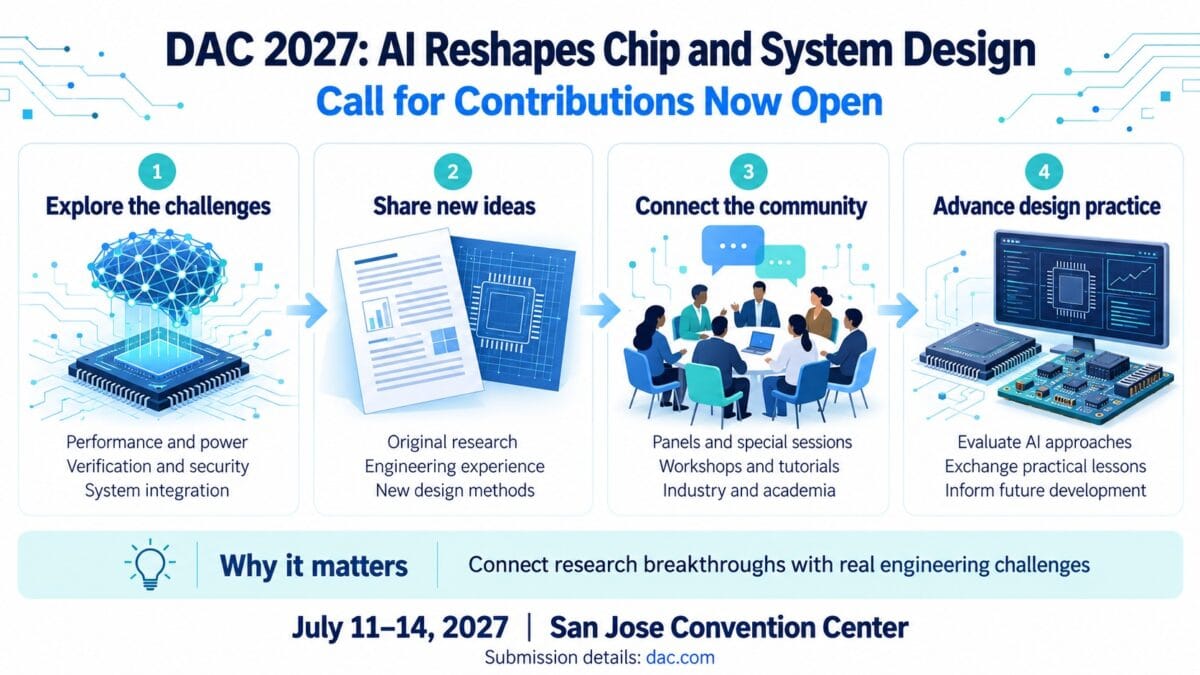
DAC, The Chips to Systems Conference, has opened its 2027 Call for Contributions, inviting researchers and industry practitioners to explore the technologies changing electronic design. Scheduled for July 11–14, 2027, at the San Jose Convention Center, the event will be DAC’s first gathering in San Jose. Its theme reflects a shift across the industry: artificial intelligence is influencing both the systems engineers build and the methods they use to build them.
‘칩에서 시스템까지(The Chips to Systems Conference)’를 모토로 하는 DAC가 전자 설계 분야를 변화시키는 기술들을 탐구하기 위해 연구원과 산업계 실무자들을 초청하는 2027년 기고(Call for Contributions) 접수를 시작했습니다. 2027년 7월 11일부터 14일까지 산호세 컨벤션 센터에서 열리는 이번 행사는 산호세에서 개최되는 최초의 DAC 모임이 될 것입니다. 이번 행사의 주제는 업계 전반의 변화를 반영하고 있습니다. 즉, 인공지능이 엔지니어들이 구축하는 시스템과 이를 구축하는 데 사용하는 방법 모두에 영향을 미치고 있다는 점입니다.
The announcement positions DAC as a meeting point for original research and practical engineering experience. Contributions will span AI, Design, electronic design automation, Security and Systems. Participants can submit research papers, engineering presentations, panel proposals, special sessions, workshops and tutorials, alongside opportunities in the DAC Pavilion and Exhibitor Forum.
이번 발표를 통해 DAC는 독창적인 연구와 실무 엔지니어링 경험이 만나는 장소로 자리매김하고 있습니다. 기고문은 AI, 설계, 전자 설계 자동화(EDA), 보안 및 시스템 분야를 아우르게 됩니다. 참가자들은 DAC 파빌리온 및 전시업체 포럼 참여 기회와 더불어 연구 논문, 엔지니어링 발표, 패널 제안, 특별 세션, 워크숍, 튜토리얼을 제출할 수 있습니다.
That breadth is important because the challenges surrounding AI do not fit neatly into a single discipline. Designing computing systems for AI applications raises questions about performance, power consumption and integration. Introducing AI into design workflows creates another set of questions about verification, reliability and how engineers assess the results produced by increasingly automated tools. DAC’s program provides several ways to examine these interconnected issues.
이러한 폭넓은 범위가 중요한 이유는 AI를 둘러싼 과제들이 단일 학문 분야에 깔끔하게 들어맞지 않기 때문입니다. AI 애플리케이션을 위한 컴퓨팅 시스템 설계는 성능, 전력 소비, 통합에 대한 의문들을 제기합니다. 설계 워크플로우에 AI를 도입하는 것은 검증, 신뢰성, 그리고 엔지니어들이 점점 더 자동화되는 도구들에 의해 생성된 결과를 어떻게 평가할 것인가에 대한 또 다른 일련의 질문들을 낳습니다. DAC의 프로그램은 이러한 상호 연결된 문제들을 검토할 수 있는 여러 방안을 제공합니다.
Agentic AI is explicitly part of the conference’s framing. Its emergence in design workflows makes the discussion more consequential than a simple comparison of productivity tools. As software takes on more complex tasks, engineering teams need to understand where automation performs well, where oversight remains necessary and how to establish confidence in its output. Contributions grounded in evidence and implementation experience can help clarify those boundaries.
에이전틱 AI(Agentic AI)는 이번 콘퍼런스의 기조에 명시적으로 포함되어 있습니다. 설계 워크플로우에서 에이전틱 AI의 등장은 단순한 생산성 도구 그 이상으로 이번 논의를 훨씬 더 중대하게 만듭니다. 소프트웨어가 더 복잡한 작업을 맡게 됨에 따라, 엔지니어링 팀은 자동화가 어디서 우수한 성능을 발휘하는지, 어디서 인간의 감독이 여전히 필요한지, 그리고 그 결과물에 대한 신뢰를 어떻게 구축해야 하는지 이해해야 합니다. 증거와 구현 경험에 기반한 기고문들은 이러한 경계선을 명확히 하는 데 도움을 줄 수 있습니다.
The engineering tracks offer a route for that practical knowledge. They cover front-end design, back-end design, intellectual property, and systems and software, with additional opportunities for engineering special sessions. These categories reflect the range of work required to turn a design concept into an electronic product. They also encourage discussion of problems encountered across different stages of development.
엔지니어링 트랙은 이러한 실무적 지식을 얻을 수 있는 경로를 제공합니다. 프론트엔드 설계, 백엔드 설계, 지식재산권(IP), 시스템 및 소프트웨어를 아우르며, 엔지니어링 특별 세션을 위한 추가 기회도 제공합니다. 이러한 범주들은 설계 개념을 전자 제품으로 구체화하는 데 필요한 광범위한 작업들을 반영합니다. 또한 개발의 서로 다른 단계에서 마주치는 문제들에 대한 토론을 장려합니다.
Research contributions serve a complementary purpose. New methods need a forum where their assumptions, results and limitations can be examined. Panels and special sessions can bring competing approaches into the same conversation, while workshops and tutorials can help participants understand unfamiliar techniques. Together, these formats create opportunities to move knowledge between academic investigation, tool development and engineering practice.
연구 기고문들은 보완적인 목적을 수행합니다. 새로운 방법론들은 그 가정, 결과, 한계가 검토될 수 있는 공론장을 필요로 합니다. 패널 토론과 특별 세션은 상반된 접근법들을 동일한 대화 테이블에 올려놓을 수 있으며, 워크숍과 튜토리얼은 참가자들이 낯선 기법들을 이해하는 데 도움을 줍니다. 이러한 형식들이 함께 어우러져 학술적 연구, 도구 개발, 그리고 엔지니어링 실무 사이에 지식이 이전될 수 있는 기회를 만들어냅니다.
The move to San Jose gives the conference a setting close to the semiconductor, software and systems companies concentrated in Silicon Valley. That proximity could support exchanges between international contributors and local industry teams. However, the announcement also emphasizes participation from the global design community, including established specialists, emerging researchers and engineers offering new perspectives.
산호세로의 이전은 콘퍼런스에 실리콘밸리에 밀집해 있는 반도체, 소프트웨어, 시스템 기업들과 인접한 개최지를 제공합니다. 이러한 지리적 근접성은 국제적인 기고자들과 지역 산업계 팀들 간의 교류를 뒷받침할 수 있습니다. 다만 이번 발표는 또한 기존 전문가, 신진 연구원, 새로운 관점을 제시하는 엔지니어를 포함해 글로벌 설계 커뮤니티의 폭넓은 참여를 강조하고 있습니다.
DAC 2027’s leadership similarly spans academia and industry. General Chair David Z. Pan represents The University of Texas at Austin and DeepWeave, while Vice Chair Natarajan Viswanathan comes from Cadence Design Systems. Technical Program Chair Ambar Sarkar of NVIDIA is joined by co-chairs Rajiv Joshi of IBM and Jiang Hu of Texas A&M University.
DAC 2027의 리더십 역시 학계와 산업계를 아우르고 있습니다. 오스틴 텍사스 대학교와 딥위브(DeepWeave)의 데이비드 Z. 판(David Z. Pan)이 일반 의장(General Chair)을 맡았으며, 부의장(Vice Chair)으로는 케이던스 디자인 시스템즈(Cadence Design Systems)의 나타라잔 비스와나탄(Natarajan Viswanathan)이 참여합니다. 기술 프로그램 의장(Technical Program Chair)인 엔비디아의 암바르 사르카르(Ambar Sarkar)와 함께 IBM의 라지브 조시(Rajiv Joshi)와 텍사스 A&M 대학교의 장 후(Jiang Hu)가 공동 의장으로 합류합니다.
Why does the call matter now? It creates an opportunity to shape the technical conversation before the conference program is finalized. Contributors can bring forward unresolved problems, challenge prevailing assumptions and share lessons that other teams can use. For practitioners, that means documenting engineering experience. For researchers, it means connecting proposed advances with the constraints facing real development programs.
지금 이 기고 요청이 중요한 이유는 무엇일까요? 이는 콘퍼런스 프로그램이 최종 확정되기 전에 기술적 대화의 방향을 형성할 기회를 만들어주기 때문입니다. 기고자들은 미해결 과제들을 제기하고, 지배적인 가정들에 도전하며, 다른 팀들이 활용할 수 있는 교훈들을 공유할 수 있습니다. 실무자들에게 이는 엔지니어링 경험을 문서화하는 것을 의미합니다. 연구원들에게는 제안된 발전 사항들을 실제 개발 프로그램들이 직면한 제약 조건들과 연결하는 것을 의미합니다.
The strongest contributions will help distinguish demonstrated progress from ambitious claims. AI’s expanding role makes careful evaluation especially valuable: a promising technique must be understood in terms of its accuracy, cost, applicability and limitations. The conference offers a forum for those discussions, although its eventual impact will depend on the quality of submissions and exchanges.
가장 뛰어난 기고문들은 입증된 진전 사항과 야심 찬 주장을 구분하는 데 도움을 줄 것입니다. AI의 역할이 확대됨에 따라 면밀한 평가는 특히 가치 있습니다. 즉, 유망한 기법은 그 정확성, 비용, 적용 가능성, 그리고 한계의 관점에서 이해되어야 합니다. 콘퍼런스는 그러한 논의를 위한 장을 제공하지만, 궁극적인 영향력은 제출된 내용의 품질과 교류의 수준에 좌우될 것입니다.
Bottom line: The announcement is therefore more than an invitation to present. It asks the design community to help define how chips, tools and systems evolve together. Prospective contributors should consult DAC’s official call for the submission categories, requirements and deadlines. The significance lies in turning distributed expertise into knowledge engineers can examine, apply and build upon as AI reshapes electronic design.
요약하자면: 이번 발표는 단순히 프레젠테이션 초청 그 이상의 의미를 갖습니다. 이는 설계 커뮤니티를 향해 칩, 도구, 시스템이 어떻게 함께 진화해야 하는지를 정의하는 데 힘을 보태달라고 요청하는 것입니다. 예비 기고자들은 제출 범주, 요구사항, 마감일에 대해 DAC의 공식 기고 안내를 참고해야 합니다. 그 중요성은 분산된 전문 지식을 엔지니어들이 검토하고, 적용하며, AI가 전자 설계를 재편함에 따라 그 위에서 발전시켜 나갈 수 있는 지식으로 전환하는 데 있습니다.