SEMICON West 2026: AI Made the Steps Faster. The Time Between Them Is Next.
The semiconductor industry crossed $1 trillion in annual revenue this year, almost four years ahead of earlier projections. SEMI President and CEO Ajit Manocha opened the CEO Summit at SEMICON West with a chart that told the story. A year ago, the forecast for 2030 was $1 trillion. Now it is $2 trillion, with $3 trillion possible by 2035. The industry has 102 new fabs coming online through 2029 and needs more than 50 beyond that by 2035.
반도체 산업은 올해 연간 매출 1조 달러를 돌파했으며, 이는 당초 예상보다 거의 4년이나 앞선 기록입니다. 세미(SEMI)의 아짓 마노차(Ajit Manocha) 회장 겸 CEO는 SEMICON 웨스트의 CEO 서밋에서 이 이야기를 증명하는 차트와 함께 기조연설을 시작했습니다. 1년 전만 해도 2030년 예상 매출은 1조 달러였으나, 이제는 2조 달러로 상향되었으며 2035년에는 3조 달러 달성도 가능할 것으로 전망됩니다. 반도체 산업은 2029년까지 102개의 새로운 팹(Fab)을 가동할 예정이며, 2035년까지 그 외에 50개 이상의 팹이 추가로 필요할 것으로 예상됩니다.
Money and capacity won’t carry that growth alone. Synopsys CEO Sassine Ghazi named the shortage of engineers as the industry’s challenge. Brooks Automation CEO Dave Jarzynka pointed out that a wafer spends only about 25% of its time in the fab actually being processed. AMD’s Justin Murrill summed up the mood in two lines: “Constraints don’t prevent progress. They guide where the next breakthrough comes from.”
자금과 생산 능력만으로 이러한 성장을 모두 이뤄낼 수는 없습니다. 시놉시스(Synopsys)의 사신 가지(Sassine Ghazi) CEO는 엔지니어 부족을 업계의 최대 난제로 꼽았습니다. 브룩스 오토메이션(Brooks Automation)의 데이브 자진카(Dave Jarzynka) CEO는 웨이퍼가 팹 안에서 실제로 공정이 진행되는 시간은 전체의 약 25%에 불과하다고 지적했습니다. AMD의 저스틴 머릴(Justin Murrill)은 업계의 분위기를 두 줄로 요약했습니다. “제약(Constraints)은 진전을 가로막지 않습니다. 오히려 제약이 다음 혁신이 어디서 와야 하는지 방향을 제시해 줍니다.”
The question underneath it all was how to deliver more, faster, with the people and factories we have. I spent Tuesday, October 13, in Room 20 at Moscone North for the design session, “Bridging Design and Manufacturing with AI,” and it took that question on directly. Speakers from TSMC, Intel, Applied Materials, Lam Research, Cadence, Silvaco, PDF Solutions, McKinsey, Cerebras, SanDisk, and VerifAIX covered everything from atoms to agents. Seven themes stood out:
- AI is expanding the solution space
- AI’s real payoff is faster learning, not cost reduction
- AI is compressing the steps, and the time between them is the next frontier
- Co-optimization is replacing the sequential handoff
- Design is speeding up, manufacturing is not
- Autonomous design is causing trust issues
- Digital twins are changing how development gets done
이 모든 것의 기저에 깔린 핵심 질문은 우리가 보유한 인력과 공장을 가지고 어떻게 더 많은 산출물을 더 빠르게 만들어낼 것인가 하는 점입니다. 필자는 10월 13일 화요일, 모스콘 노스(Moscone North) 룸 20에서 열린 디자인 세션 “AI로 디자인과 제조를 연결하기(Bridging Design and Manufacturing with AI)”에 참석해 이 질문을 직접적으로 다루었습니다. TSMC, 인텔, 어플라이드 머티어리얼즈, 램리서치, 케이던스, 실바코, PDF 솔루션즈, 맥킨지, 세레브라스, 샌디스크, 베리파이엑스(VerifAIX)의 연사들이 원자(Atoms)부터 에이전트(Agents)까지 모든 것을 다루었습니다. 다음의 7가지 주제가 두드러졌습니다.
- AI는 솔루션 공간(solution space)을 확장하고 있습니다.
- AI의 진정한 보상은 비용 절감이 아니라 더 빠른 학습입니다.
- AI는 단계들을 압축하고 있으며, 단계와 단계 사이의 시간이 다음 격전지입니다.
- 순차적 핸드오프(sequential handoff)가 공동 최적화(co-optimization)로 대체되고 있습니다.
- 디자인은 빨라지고 있지만, 제조는 그렇지 않습니다.
- 자율형 디자인은 신뢰성 문제를 야기하고 있습니다.
- 디지털 트윈이 개발 방식 자체를 바꾸고 있습니다.
AI is expanding the solution space. Lam Research’s David Fried put the number of possible process recipes on the order of 10²³. Intel’s Vikas Sharma showed a design-technology co-optimization (DTCO) search space that grew from fewer than 10 options to more than a million. Applied Materials’ Subi Kengeri described thousands of materials candidates and hundreds of coupled variables per study. No team of engineers can explore that many options on their own. ML finds the parameters that matter, and AI finds the best candidates to try.
AI는 솔루션 공간을 확장하고 있습니다. 램리서치의 데이비드 프리드(David Fried)는 가능한 공정 레시피의 수가 10²³개에 달한다고 밝혔습니다. 인텔의 비카스 샤르마(Vikas Sharma)는 DTCO(Design-Technology Co-Optimization, 설계·공정 공동 최적화) 검색 공간이 10개 미만의 옵션에서 100만 개 이상으로 확장된 모습을 보여주었습니다. 어플라이드 머티어리얼즈의 수비 켄게리(Subi Kengeri)는 연구당 수천 개의 소재 후보와 수백 개의 결합 변수가 존재한다고 설명했습니다. 그토록 많은 옵션을 인간 엔지니어 팀이 독자적으로 탐색하는 것은 불가능합니다. 머신러닝(ML)은 중요한 매개변수를 찾아내고, AI는 시도해 볼 만한 최적의 후보를 찾아냅니다.
AI’s real payoff is faster learning, not cost reduction. Sandisk said it plainly on the IEEE panel moderated by Silvaco’s Wally Rhines: AI narrows ten candidates to three before design starts, with fewer experiments and shorter cycles, and the value is speed. Intel’s DTCO decisions dropped from weeks to one or two hours. Applied Materials cut a 3D gate-all-around device simulation from 20.5 days to 19.7 hours on GPUs. Every one of these is a learning loop getting shorter.
AI의 진정한 보상은 비용 절감이 아니라 더 빠른 학습입니다. 샌디스크는 실바코의 월리 라인스(Wally Rhines)가 주재한 IEEE 패널 토론에서 이를 명확히 밝혔습니다. AI는 디자인이 시작되기도 전에 10개의 후보를 3개로 좁혀주며, 더 적은 실험과 더 짧은 주기를 가능하게 합니다. 핵심 가치는 바로 ‘속도’입니다. 인텔의 DTCO 의사결정 소요 시간은 몇 주에서 1~2시간으로 단축되었습니다. 어플라이드 머티어리얼즈는 GPU를 활용해 20.5일이 걸리던 3D GAA(Gate-All-Around) 소자 시뮬레이션을 19.7시간으로 단축했습니다. 이 모든 사례는 학습 루프(learning loop)가 점점 더 짧아지고 있음을 보여줍니다.
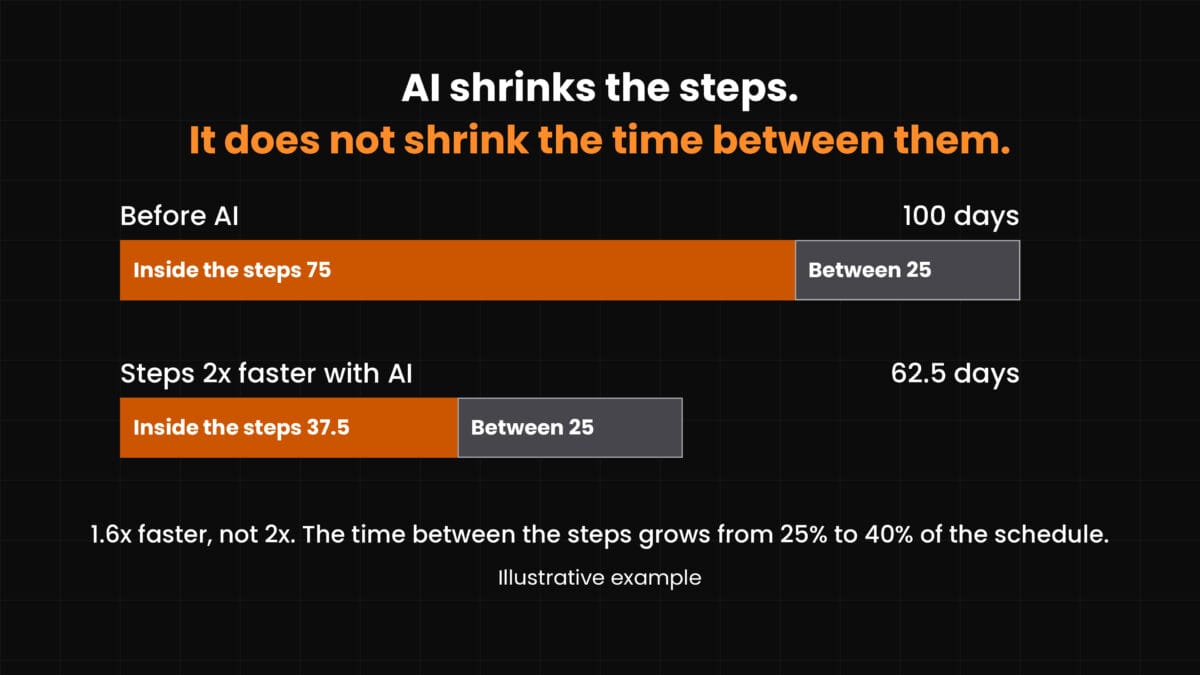
AI is compressing the steps, and the next frontier is the time between them. Cycle time inside the steps is falling fast. McKinsey showed AI-assisted programs reaching tape-out nine months after design starts and cutting debug closure time by 40%. TSMC’s agentic place-and-route runs around the clock at 3 to 5x productivity. McKinsey’s Aaron Aboagye added a related point: a meaningful share of development latency is organizational, not physical, and orchestration compresses the white space between technical steps. PDF Solutions showed test data that rarely follows the product downstream. Brooks’s 25% is the same pattern in the fab: most of a wafer’s time is spent between the steps, not in them.
AI는 단계들을 압축하고 있으며, 다음 격전지는 단계 사이의 시간입니다. 각 단계 내부의 사이클 타임(cycle time)은 빠르게 줄어들고 있습니다. 맥킨지는 AI 지원 프로그램이 디자인 시작 후 9개월 만에 테이프아웃(tape-out)에 도달하고 디버그 마감 시간을 40% 단축하는 모습을 보여주었습니다. TSMC의 에이전틱(agentic) 배치 및 배선(place-and-route) 기능은 3~5배의 생산성으로 24시간 내내 구동됩니다. 맥킨지의 아론 아보아기에(Aaron Aboagye)는 여기에 관련하여 한 가지 포인트를 더했습니다. 개발 지연의 상당 부분은 물리적인 문제가 아니라 조직적인 문제이며, 오케스트레이션(orchestration)이 기술적 단계 사이의 공백(white space)을 압축해 준다는 것입니다. PDF Solutions는 다운스트림으로 거의 전달되지 않는 테스트 데이터를 보여주었습니다. 브룩스의 ‘25%’ 법칙 역시 팹 내부에서 나타나는 동일한 패턴입니다. 웨이퍼가 소요하는 시간의 대부분은 공정 단계 자체가 아니라 단계와 단계 사이에서 허비됩니다.
I’d take McKinsey’s point one step further. As AI compresses the time inside the steps, the time between them, team to team and team to tool, becomes a bigger share of the schedule. From inside a program, that time has a cause: how the work between the steps is designed. In most programs, it was never designed at all.
필자는 맥킨지의 주장을 한 단계 더 발전시키고 싶습니다. AI가 단계 내부의 시간을 압축함에 따라, 팀 대 팀, 팀 대 툴 사이 등 ‘단계 사이의 시간’이 전체 일정에서 차지하는 비중이 더욱 커지고 있습니다. 프로그램 내부에서 이 시간은 명확한 원인을 가지고 있습니다. 바로 단계 간의 작업이 어떻게 설계되었느냐 하는 점입니다. 대부분의 프로그램에서 이 부분은 애초에 설계된 적이 없습니다.
Co-optimization is replacing the sequential handoff DTCO, and system-technology co-optimization (STCO) says the same thing: design, process, package, and system decisions get made together, not passed down a line. Applied Materials described STCO as one coupled loop, with constraints flowing down and outcomes flowing up. Intel showed that degrees of freedom and reversibility shrink as the PDK matures, so the right decisions must come early. Cerebras showed co-optimization at wafer scale, engineering the wafer, DRAM, and optics together and coupling every design domain. TSMC is moving from the PDK to an AI Design Kit built for agents. McKinsey called for persistent, cross-stack co-development in place of sequential handoffs.
순차적 핸드오프가 공동 최적화로 대체되고 있습니다. DTCO 및 STCO(System-Technology Co-Optimization, 시스템·기술 공동 최적화)는 모두 설계, 공정, 패키지, 시스템의 의사결정이 줄을 세워 순차적으로 전달되는 것이 아니라 동시에 이루어져야 함을 뜻합니다. 어플라이드 머티어리얼즈는 STCO를 제약 조건은 아래로 흐르고 결과물은 위로 올라오는 하나의 결합된 루프(coupled loop)로 설명했습니다. 인텔은 PDK(Process Design Kit)가 성숙해질수록 자유도(degrees of freedom)와 가역성(reversibility)이 줄어들기 때문에 올바른 의사결정이 조기에 이루어져야 한다고 강조했습니다. 세레브라스는 웨이퍼, D/RAM, 광학 장치를 함께 엔지니어링하고 모든 설계 영역을 결합하여 웨이퍼 스케일에서의 공동 최적화를 보여주었습니다. TSMC는 PDK에서 에이전트를 위해 구축된 AI 디자인 키트로 진화하고 있습니다. 맥킨지는 순차적 핸드오프를 대신하여 지속적이고 교차 스택(cross-stack)에 걸친 공동 개발을 촉구했습니다.
System complexity keeps rising, and engineers have had to rise with it. Technical depth used to be enough. Then we needed breadth. Now we need to understand the whole system. Co-optimization is the latest answer to that pressure, and as complexity grows, it will have to keep evolving.
시스템 복잡성은 계속해서 증가하고 있으며, 엔지니어들은 이에 발맞추어야 했습니다. 과거에는 기술적 깊이(depth)만으로도 충분했습니다. 그러다 넓은 시야(breadth)가 필요해졌고, 이제는 시스템 전체를 이해해야 합니다. 공동 최적화는 이러한 압박에 대응하는 가장 최신의 해답이며, 복잡성이 커짐에 따라 계속해서 진화해야 할 것입니다.
Design is speeding up; manufacturing is not. Manufacturing can’t iterate without physical consequences, and the physics keeps getting harder. Transistors have gone from planar to FinFET to gate-all-around, with CFET and 2D materials next. Rhines showed NAND process steps rising from about 400 to as many as 1,800, wafer lot cycle time stretching from 8 to 10 weeks at 28nm to 16 weeks or more, and mask sets climbing from $1 to 3 million to $20 to 40 million or more. McKinsey’s view: manufacturing remains largely uncompressed.
디자인은 빨라지고 있지만, 제조는 그렇지 않습니다. 제조업은 물리적인 결과물 없이 반복 작업을 할 수 없으며, 물리학의 벽은 갈수록 높아지고 있습니다. 트랜지스터는 평판(planar)에서 FinFET, GAA를 거쳐 이제는 CFET와 2D 소재로 진화하고 있습니다. 라인스는 NAND 공정 단계가 약 400개에서 최대 1,800개로 증가했으며, 웨이퍼 로트 사이클 타임은 28nm 공정의 8~10주에서 16주 이상으로 늘어났고, 마스크 세트 비용은 100만~300만 달러에서 2,000만~4,000만 달러 이상으로 치솟았다고 밝혔습니다. 맥킨지의 시각에 따르면, 제조업은 여전히 대체로 압축되지 않은 상태로 남아 있습니다.
Autonomous design is causing trust issues. VerifAIX’s Madhulima Tewari called it the correctness gap. She cited first-silicon success at 14% and the best AI pass rate on hardware code generation at 34% and argued that the system that generates an artifact can’t be the only one that certifies it. Her answer: the LLM proposes, deterministic engines decide. Cadence’s Jeff Roane said agentic AI is here now, with one to two years to figure out how to use it well. At the CEO Summit, Ghazi described the end state: you give an outcome, not a prompt, and human judgment still defines the architecture.
자율형 디자인은 신뢰성 문제를 야기하고 있습니다. 베리파이엑스의 마둘리마 테와리(Madhulima Tewari)는 이를 ‘정확성 격차(correctness gap)’라고 명명했습니다. 그녀는 첫 실리콘 성공률이 14%에 불과하고 하드웨어 코드 생성에 대한 최고의 AI 통과율도 34%에 그친다는 점을 언급하며, 아티팩트(artifact)를 생성한 시스템이 그것을 검증(certify)하는 유일한 시스템이 되어서는 안 된다고 주장했습니다. 그녀의 해답은 LLM이 제안하고, 결정론적 엔진(deterministic engines)이 최종 결정을 내리게 하는 것입니다. 케이던스의 제프 로앤(Jeff Roane)은 에이전틱 AI가 이미 우리 곁에 와 있으며, 이를 잘 활용하는 방법을 알아내는 데 1~2년의 시간이 걸릴 것이라고 말했습니다. CEO 서밋에서 가지(Ghazi)는 최종적인 도달점을 다음과 같이 설명했습니다. 즉, 프롬프트를 주는 것이 아니라 ‘결과물(outcome)’을 제시하면, 아키텍처는 여전히 인간의 판단이 정의하게 된다는 것입니다.
Digital twins are changing how development gets done. Systems are getting harder for any one engineer to understand, which is why digital twins are becoming so important. Models and virtual prototypes help development teams see how the pieces interact. Physical prototypes teach the same lessons, but every learning cycle on silicon costs weeks and millions of dollars. Rhines called the virtualization of manufacturing inevitable. Physics simulation trains surrogate models that let teams test process changes before running a wafer. Lam builds virtual twins of process and fab, and Applied Materials uses the same surrogate pattern from materials to system. The twins run on data, and the data is exploding. PDF Solutions’ Kimon Michaels cited Qualcomm’s engineering and manufacturing data growing 600% since 2022, while less than 5% of manufacturing data gets analyzed. A twin is only as good as its calibration.
디지털 트윈이 개발 방식 자체를 바꾸고 있습니다. 시스템이 너무 복잡해져서 그 어떤 엔지니어 한 명도 온전히 이해하기 어려워지고 있으며, 이 때문에 디지털 트윈이 그토록 중요해지고 있습니다. 모델과 가상 프로토타입은 개발 팀이 각 부품들이 어떻게 상호작용하는지 파악할 수 있도록 돕습니다. 물리적 프로토타입도 같은 교훈을 주지만, 실리콘 상에서 이루어지는 모든 학습 사이클은 수주 간의 시간과 수백만 달러의 비용을 소모합니다. 라인스는 제조업의 가상화(virtualization)가 불가피하다고 역설했습니다. 물리 시뮬레이션은 대리 모델(surrogate models)을 훈련시키며, 이를 통해 팀은 웨이퍼를 구동하기 전에 공정 변경 사항을 미리 테스트할 수 있습니다. 램리서치는 공정과 팹의 가상 트윈을 구축하고 있으며, 어플라이드 머티어리얼즈는 소재부터 시스템에 이르기까지 동일한 대리 모델 패턴을 활용하고 있습니다. 트윈은 데이터로 구동되지만, 데이터는 폭발적으로 증가하고 있습니다. PDF Solutions의 키몬 마이클스(Kimon Michaels)는 퀄컴의 엔지니어링 및 제조 데이터가 2022년 이후 600% 증가한 반면, 제조 데이터의 5% 미만만 분석되고 있다고 지적했습니다. 트윈은 캘리브레이션(보정)이 정확할 때만 가치가 있습니다.
Across all seven themes, the pattern was the same: AI is making each step faster and each search smarter. Lam’s own research, published in Nature, put the lesson plainly: engineers and algorithms working together, with the handoff in the right place, cut the cost of reaching a process target in half. That handoff is a design decision, and so is every other boundary in the flow, between design and manufacturing, between teams, between companies. When an agent can run place-and-route around the clock, your schedule stops being set by how fast your engineer works. It is set by how fast decisions, data, and learning move across those boundaries. The $1 trillion was built on faster tools. The next trillion goes to the companies that design how their people and tools work together.
이 7가지 주제 전반에 걸쳐 패턴은 동일했습니다. AI는 각 단계를 더 빠르게 만들고 모든 탐색 과정을 더 스마트하게 만들고 있습니다. ‘네이처(Nature)’에 발표된 램리서치의 자체 연구는 이 교훈을 명쾌하게 보여주었습니다. 엔지니어와 알고리즘이 협력하고 올바른 지점에서 핸드오프가 이루어질 때, 공정 목표에 도달하는 비용이 절반으로 줄어들었습니다. 그 핸드오프는 디자인의 의사결정이며, 디자인과 제조 사이, 팀 간, 기업 간의 흐름에 존재하는 모든 경계 역시 마찬가지입니다. 에이전트가 24시간 내내 배치 및 배선을 수행할 수 있게 되면, 일정은 엔지니어가 얼마나 빨리 일하느냐에 의해 좌우되지 않습니다. 그 일정은 의사결정, 데이터, 그리고 학습이 그러한 경계들을 얼마나 빠르게 넘나드느냐에 의해 결정됩니다. 1조 달러는 더 빠른 툴 위에 지어졌습니다. 그다음의 2조 달러는 사람과 툴이 협력하는 방식을 설계하는 기업들의 몫이 될 것입니다.