SEMICON West’s Autonomous Fab Vision Needs a Decision-Escalation Design
By Gleb Tsipursky
SEMICON West 2026’s smart-manufacturing agenda connected digital twins, agentic AI, physical AI, and increasingly autonomous factory operations. The final day included a session on automation and equipment for autonomous facilities. At its October CONNECT conference, PDF Solutions planned demonstrations of Exensio Aurora, an analytics architecture designed to support agentic AI across semiconductor manufacturing operations and the supply chain.
SEMICON West 2026의 스마트 제조 어젠다는 디지털 트윈, 에이전틱 AI(agentic AI), 피지컬 AI, 그리고 점차 자율화되는 공장 운영을 하나로 연결지었습니다. 마지막 날에는 자율형 시설을 위한 자동화 및 장비 세션이 진행되었습니다. PDF 솔루션즈(PDF Solutions)는 10월 CONNECT 컨퍼런스에서 반도체 제조 공정과 공급망 전반에 걸쳐 에이전틱 AI를 지원하도록 설계된 분석 아키텍처인 ‘엑센시오 오로라(Exensio Aurora)’의 시연을 계획했습니다.
These announcements indicate the direction of investment, although product specifications and conference demonstrations do not establish performance inside a production fab. The immediate management question is practical: When may an AI-generated recommendation become an authorized action, and who is accountable for that decision?
이러한 발표들은 투자의 방향성을 보여주지만, 제품 사양이나 컨퍼런스 시연이 실제 생산 팹 내부에서의 성능을 입증하는 것은 아닙니다. 현장의 경영진이 마주하는 당면 과제는 실무적인 것입니다. 즉, AI가 생성한 권고안이 언제 승인된 조치가 될 수 있으며, 그 결정에 대해 누가 책임을 져야 하는가 하는 점입니다.
An AI system might identify a correlation between an equipment signal and a change in yield. An engineer must still determine whether the signal reflects an instrument issue, an unusual material lot, a recent maintenance event, or a genuine process shift. In exploratory analysis, the pattern may justify further investigation. On a live production line, it cannot automatically justify a process-setting change.
AI 시스템은 장비 신호와 수율 변화 간의 상관관계릴 찾아낼 수 있습니다. 하지만 엔지니어가 해당 신호가 계기 문제 때문인지, 특이한 자재 로트(lot) 때문인지, 최근의 유지보수 이벤트 때문인지, 아니면 실제 공정상의 변화 때문인지 여전히 판단해야 합니다. 탐색적 분석 단계에서는 해당 패턴이 추가적인 조사를 정당화할 수 있습니다. 그러나 실제 가동 중인 생산 라인에서는 공정 설정 변경을 자동으로 정당화할 수 없습니다.
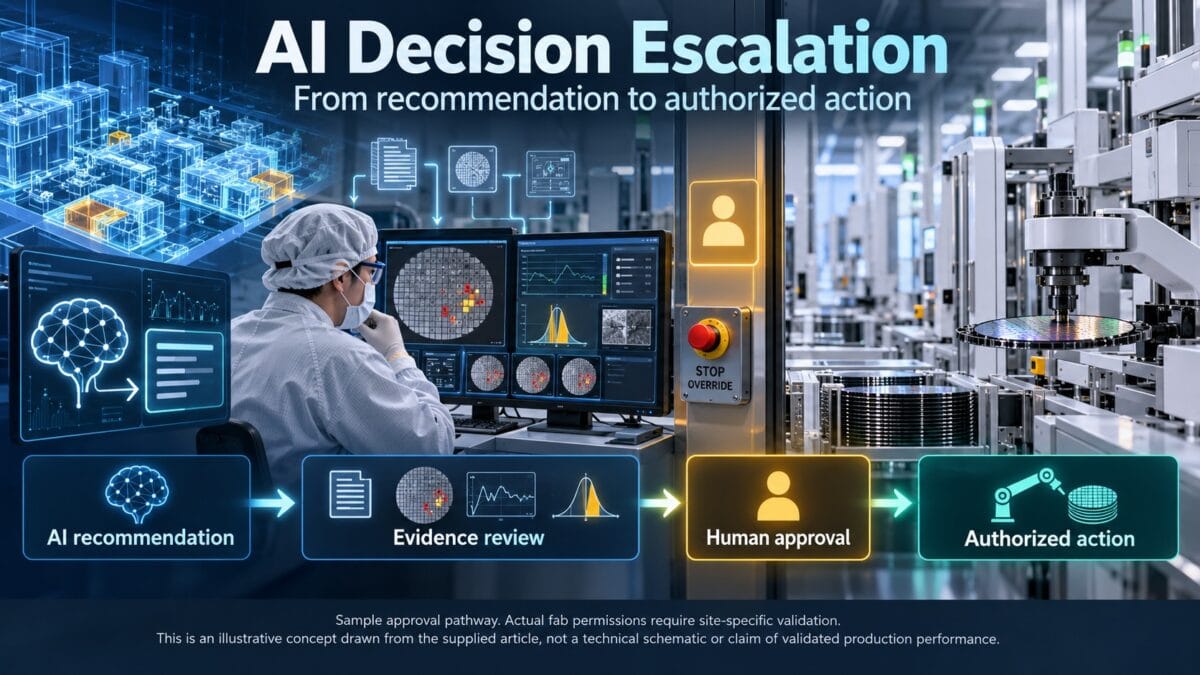
Fab leaders should therefore design decision-escalation rules into workflows before granting an agent operational authority.
따라서 팹 리더들은 에이전트에게 운영 권한을 부여하기에 앞서 워크플로 내에 의사결정 에스컬레이션 규칙을 설계해야 합니다.
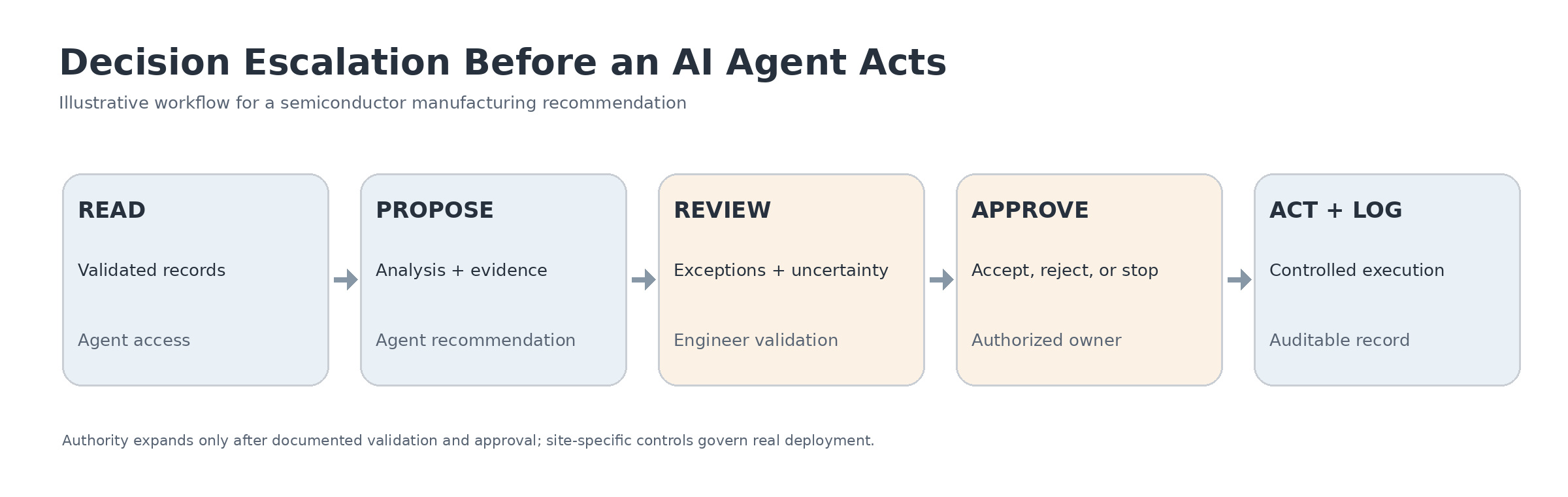
Start with precise permission boundaries. Separate agents allowed to retrieve records and draft explanations from those permitted to initiate holds, propose parameter changes, or alter tool instructions. An agent might recommend an action while an authorized engineer or operations leader determines whether to approve it. A general promise to keep humans in the loop offers little protection unless teams specify the decisions, reviewers, required evidence, and permissible autonomy.
정밀한 권한 경계부터 시작하십시오. 기록을 조회하고 설명을 초안으로 작성할 수 있는 에이전트와, 생산 중단(hold)을 개시하거나, 파라미터 변경을 제안하거나, 툴 지시사항을 수정할 수 있는 에이전트를 구분하십시오. 승인된 엔지니어나 운영 책임자가 승인 여부를 결정하는 동안, 에이전트는 조치를 권고할 수 있습니다. 인간을 의사결정 루프 안에 계속 두겠다는 막연한 약속은, 팀이 구체적인 결정 사항, 검토자, 요구되는 증거, 그리고 허용 가능한 자율성의 범위를 명시하지 않는 한 거의 보호 장치가 되지 못합니다.
Make every handoff traceable. A process engineer receiving an AI recommendation should see the source data, affected tools or lots, known uncertainties, and intended effect. Record who reviewed the evidence, which competing explanations they considered, and whether the suggestion was accepted or rejected. A fluent explanation should never replace the traceable record beneath it.
모든 인수인계를 추적 가능하게 만드십시오. AI 권고안을 받는 공정 엔지니어는 소스 데이터, 영향을 받는 툴 또는 로트, 알려진 불확실성, 그리고 의도된 효과를 확인할 수 있어야 합니다. 어떤 사람이 증거를 검토했고, 어떤 대안적 설명들을 고려했으며, 제안이 수용되었는지 아니면 거부되었는지를 기록하십시오. 유창한 설명이 그 밑에 있는 추적 가능한 기록을 대체할 수는 없습니다.
Create the exception path during testing. Include missing telemetry, contradictory process indicators, a tool returning from maintenance, an unusual material lot, and an apparent improvement followed by a downstream quality problem. Decide which exceptions suspend automation, which require a second reviewer, and who can restart a stopped workflow. People need explicit authority to challenge an agent’s recommendation without pressure to protect a rollout’s productivity targets.
테스트 과정에서 예외 경로를 만드십시오. 누락된 텔레메트리, 상반되는 공정 지표, 유지보수에서 복귀한 툴, 특이한 자재 로트, 그리고 겉보기에는 개선되었으나 후속 공정에서 품질 문제가 발생하는 경우 등을 포함시키십시오. 어떤 예외 상황이 자동화를 일시 중단시키고, 어떤 상황에 두 번째 검토자가 필요하며, 중단된 워크플로를 누가 다시 시작할 수 있는지 결정하십시오. 사람들은 생산성 목표를 달성해야 한다는 압박 없이 에이전트의 권고에 이의를 제기할 수 있는 명시적인 권한이 필요합니다.
Then measure decisions rather than dashboard activity. Track time to identify and investigate actionable anomalies, recommendations reversed after review, repeat exceptions, and engineering hours spent verifying suggestions. Where possible, connect those measures to controlled comparisons involving cycle time, scrap, and yield. Faster analysis can still slow the operation if it shifts hidden verification work onto engineers.
그런 다음 대시보드 활동량 대신 의사결정을 측정하십시오. 조치 가능한 이상 징후를 식별하고 조사하는 데 걸리는 시간, 검토 후 철회된 권고안, 반복되는 예외 상황, 그리고 제안을 검증하는 데 소요된 엔지니어의 근무 시간을 추적하십시오. 가능하다면 이러한 측정 지표를 사이클 타임, 불량률(scrap), 수율과 관련된 통제 비교 실험과 연결하십시오. 숨겨진 검증 작업을 엔지니어에게 전가한다면, 더 빠른 분석이라 하더라도 오히려 작업 속도를 늦출 수 있습니다.
The workforce design matters too. Experienced process engineers may question an opaque recommendation because they have seen plausible correlations fail under changing production conditions. Give those engineers a formal role in constructing test cases and defining stop rules. Their objections can reveal technical failure modes that a data team overlooks.
인력 구성 설계 또한 중요합니다. 숙련된 공정 엔지니어는 변화하는 생산 조건 속에서 타당해 보이던 상관관계가 실패하는 것을 목격해 왔기 때문에, 모호한 권고안에 대해 의문을 제기할 수 있습니다. 그 엔지니어들에게 테스트 케이스를 구축하고 중단 규칙을 정의하는 공식적인 역할을 부여하십시오. 이들의 이반은 데이터 팀이 간과하기 쉬운 기술적 실패 모드를 드러내 줄 수 있습니다.
Junior engineers face a different risk. If an agent supplies the apparent diagnosis first, they may get fewer opportunities to practice the reasoning required when the system is mistaken. Preserve structured reviews where employees inspect evidence and defend competing explanations before comparing their conclusions with the agent’s output.
주니어 엔지니어들은 이와는 다른 위험에 직면합니다. 에이전트가 겉보기 진단을 먼저 제시할 경우, 시스템이 오류를 범했을 때 필요한 추론 능력을 연습할 기회가 줄어들 수 있습니다. 직원들이 증거를 검토하고 대안적 설명들을 옹호한 뒤 자신들의 결론을 에이전트의 결과물과 비교하는 구조화된 리뷰 과정을 유지하십시오.
The CONNECT 2026 agenda demonstrates the growing commercial focus on AI-driven manufacturing analysis. As fab operators move toward delegated decisions, leaders should be able to answer three questions about any agent-initiated action: What evidence supported it? Who could stop or override it? How will we know whether the decision improved performance?
CONNECT 2026의 어젠다는 AI 기반 제조 분석에 대한 커지는 상업적 관심을 보여줍니다. 팹 운영자들이 위임된 의사결정으로 나아감에 따라, 리더들은 에이전트가 주도한 모든 조치에 대해 다음 세 가지 질문에 답할 수 있어야 합니다. 어떤 증거가 이를 뒷받침했는가? 누가 이를 중단시키거나 무력화(override)할 수 있는가? 이 결정이 성능을 향상시켰는지 어떻게 알 수 있는가?
Gleb Tsipursky, PhD, is a behavioral scientist, CEO of Disaster Avoidance Experts, and author of The Psychology of AI Adoption at Work: From Resistance to Results (Georgetown University Press, 2026).
글레브 시푸르스키(PhD)는 행동 과학자이자, '재난 회피 전문가들(Disaster Avoidance Experts)'의 CEO이며, 《직장에서의 AI 도입 심리학: 저항에서 성과로(The Psychology of AI Adoption at Work: From Resistance to Results)》(조지타운 대학교 출판부, 2026)의 저자입니다.