Who Gets to Move the Recipe? How Autonomous Agents Earn Decision Authority in the Fab
by Ajay Kumar Govindaram
아제이 쿠마르 고빈다람(Ajay Kumar Govindaram) 글
There’s a question I’ve started asking at every agentic AI demo I sit through, and it has a clean answer in every fab on earth: who is allowed to change the recipe? In a semiconductor factory, that was settled decades ago. A person doesn’t touch a production recipe because they feel confident. They touch it because they hold a qualification, the change passed management of change, and an out-of-control action plan told them exactly what’s permitted when a chart goes sideways. Authority is granted on evidence and revoked on evidence. Every time. Now put an autonomous agent in that same aisle, one that can triage a fault-detection alarm or nudge a run-to-run setpoint, and ask again. The fab already knows how to answer it. Most agent platforms simply haven’t been asked yet.
내가 참여하는 모든 에이전틱 AI(Agentic AI) 데모 행사에서 항상 던지는 질문이 하나 있다. 그리고 이 질문에 대해 전 세계의 모든 반도체 팹(fab)은 명확한 답을 가지고 있다. 바로 “누가 공정 레시피를 변경할 권한을 가지고 있는가?”라는 질문이다. 반도체 공장에서는 이 문제가 수십 년 전에 이미 해결되었다. 작업자는 자신이 잘 안다고 해서 마음대로 생산 레시피를 건드리지 않는다. 자격을 보유하고 있어야 하고, 변경 관리(Management of Change) 절차를 거쳤으며, 공정 차트가 튈 때 정확히 무엇이 허용되는지 규정한 '이상 조치 계획(Out-of-Control Action Plan)'에 부합할 때만 손을 댄다. 권한은 증거에 기반해 부여되고, 증거에 기반해 박탈된다. 예외 없이 언제나 그렇다. 그렇다면 이제 동일한 공정에 결함 감지 경보를 분류하거나 런투런(Run-to-Run) 설정값을 미세 조정할 수 있는 자율형 에이전트를 배치하고 다시 질문을 던져보자. 팹은 이미 이에 답하는 법을 알고 있다. 다만 대다수의 AI 에이전트 플랫폼은 아직 이 질문을 받아본 적이 없을 뿐이다.
That gap is where I want to spend this article. I think the semiconductor industry is sitting on the best framework anyone has for governing agentic AI, and it predates the technology by forty years.
이러한 간극이 바로 이 글에서 다루고자 하는 주제이다. 반도체 산업은 에이전틱 AI를 통제하기 위해 세상에 존재하는 가장 훌륭한 프레임워크를 이미 쥐고 있으며, 이는 해당 기술보다 무려 40년이나 앞서 완성된 것이다.
The Question Every Agentic Pilot Skips
Walk the exhibition floor at any industry event this year and you’ll hear the same pitch: an agent that watches your process data, finds the anomaly, and acts. The demos are good. The recommendations are often right. And then the pilot stalls in the same place every time, the moment someone in process engineering asks the uncomfortable question. When is this thing allowed to act on its own? Who signed off on that? What happens to its privileges when its behavior changes next quarter?
Silence.
올해 어떤 산업 전시회의 전시장 플로어를 걸어다녀도 똑같은 영업 피칭을 듣게 될 것이다. 바로 공정 데이터를 모니터링하고, 이상 징후를 찾아내며, 조치를 취하는 에이전트라는 설명이다. 데모는 훌륭하고, 추천 결과도 대개 맞다. 하지만 공정 엔지니어링 부서의 누군가가 불편한 질문을 던지는 순간, 파일럿 프로젝트는 매번 똑같은 지점에서 멈춰 선다. “이 녀석이 언제 스스로 조치를 취할 수 있지?” “누가 거기에 서명했어?” “다음 분기에 이 녀석의 행동 패턴이 바뀌면 권한은 어떻게 되지?”
침묵.
Most agentic systems have no answer, because they were built to be smart, not to be governed. So the fab does the only safe thing it can and keeps a human on every single action. The agent becomes an expensive suggestion box, and the business case (the one that assumed some decisions would eventually run unattended) never closes.
대다수의 에이전틱 시스템은 이에 대한 답을 가지고 있지 않다. 통제되도록 설계된 것이 아니라 똑똑하게 만들어지는 데 집중했기 때문이다. 그래서 팹은 취할 수 있는 유일한 안전 조치로 모든 단일 작업에 인간을 남겨둔다. 에이전트는 결국 비싼 제안 상자에 불과하게 되고, (일부 의결이 결국 무인으로 처리될 것이라 가정했던) 비즈니스 케이스는 결코 완성되지 못한다.
Gartner has predicted that over 40% of agentic AI projects will be canceled by the end of 2027, pointing to escalating costs, unclear business value, and inadequate risk controls (Gartner, June 2025). In a fab, I’d argue the risk-control part of that list is most of the story. An ignored recommendation costs a few minutes. An unauthorized recipe change costs every wafer that runs before someone catches it, and that asymmetry is why “the model is accurate” was never going to be enough.
가트너(Gartner)는 2027년 말까지 에이전틱 AI 프로젝트의 40% 이상이 비용 증가, 불분명한 비즈니스 가치, 부적절한 리스크 통제를 이유로 취소될 것이라고 예측했다(가트너, 2025년 6월). 팹의 관점에서 보면, 그 목록 중 리스크 통제 부분이 문제의 대부분을 차지한다고 감히 말하고 싶다. 무시된 권고 사항은 몇 분의 시간 손실을 초래할 뿐이지만, 승인되지 않은 레시피 변경은 누군가 알아채기 전에 실행되는 모든 웨이퍼를 망가뜨린다. 바로 이러한 비대칭성 때문에 “모델이 정확하다”는 것만으로는 결코 충분하지 않았던 것이다.
The Fab Already Solved This, Just Not for Software
Here’s the part that excited me when it clicked: the fab doesn’t have a gap here at all. It runs a mature, audited, boring-in-the-best-way system that settles exactly which actor may alter which parameter, under what circumstances, and backed by what evidence. We just never pointed it at software. Nobody thought to.
이것이 퍼즐처럼 딱 맞아떨어졌을 때 나를 전율케 한 부분이다. 팹에는 이와 관련한 간극이 애초에 존재하지 않는다. 팹은 어떤 주체가 어떤 상황에서, 어떤 증거를 바탕으로, 어떤 파라미터를 변경할 수 있는지 정확하게 규정하는 성숙하고, 감사를 거치며, 가장 모범적인 의미에서 '지루한' 시스템을 가동하고 있다. 우리는 단지 그것을 소프트웨어에 적용해 볼 생각을 미처 못 했을 뿐이다.
Think about what already governs a process engineer. Tool qualification establishes that a person or system is competent before they get near production. Statistical process control says, continuously, whether a process is behaving inside its limits. An out-of-control action plan specifies the exact response when it isn’t, including who may act and what they may do. Management of change gates any permanent modification behind review and sign-off. None of it trusts anyone because they seem reliable; it demands evidence, and it withdraws permission the moment the evidence turns.
공정 엔지니어를 통제하는 요소들을 생각해보라. 툴 자격 부여(Tool Qualification)는 사람이나 시스템이 생산 라인에 접근하기 전에 역량을 갖추고 있음을 확립한다. 통계적 공정 관리(SPC)는 공정이 허용 한계 내에서 작동하고 있는지 지속적으로 판단한다. 이상 조치 계획(OCAP)은 그렇지 않을 경우 누구 가 행동할 수 있고 무엇을 할 수 있는지를 포함하여 정확한 대응 방식을 명시한다. 변경 관리(MOC)는 모든 영구적 수정 사항을 검토 및 승인 절차 뒤에 둔다. 이 중 어느 것도 누군가 신뢰할 만해 보인다는 이유로 그를 신뢰하지 않는다. 철저히 증거를 요구하며, 증거가 어긋나는 순간 권한을 회수한다.
An agent is just a new kind of operator. A fast one, a tireless one, one that reads more sensor channels than any human can hold in their head, but an operator all the same. And the fab already knows how to onboard an operator who hasn’t yet earned the right to act alone. So the design problem isn’t “how do we govern AI.” It’s “how do we enroll this new operator into the governance we already run,” and that reframing changes everything downstream.
에이전트는 새로운 형태의 작업자에 불과하다. 빠르고, 지치지 않으며, 인간이 머릿속에 담을 수 있는 것보다 더 많은 센서 채널을 읽어내는 작업자이지만, 결국은 작업자일 뿐이다. 그리고 팹은 아직 혼자서 행동할 자격을 얻지 못한 새로운 작업자를 온보딩하는 방법을 이미 알고 있다. 따라서 설계의 문제는 “어떻게 AI를 통제할 것인가”가 아니라 “이 새로운 작업자를 우리가 이미 운영 중인 거버넌스 체계에 어떻게 편입시킬 것인가”가 되며, 이러한 관점의 전환은 그 이후의 모든 것을 바꾼다.
Four Levels, and Nobody Starts at the Top
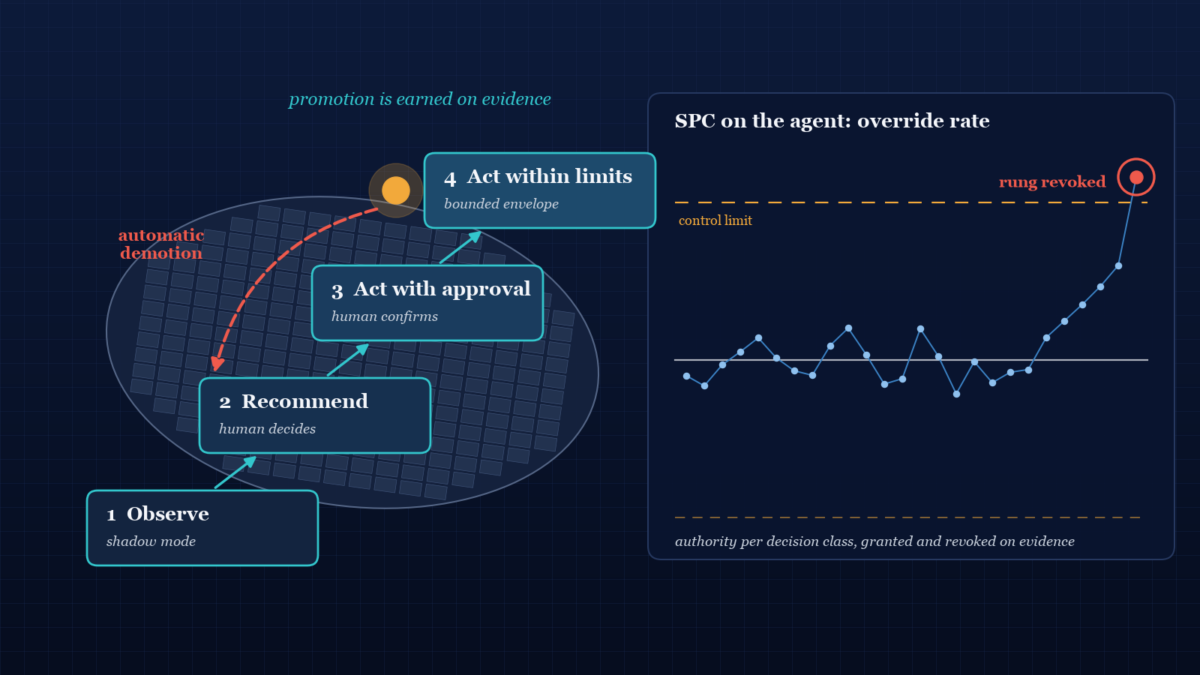
The practical core is an autonomy ladder. Every class of decision an agent might touch gets a level, and the levels are deliberately unglamorous.
실무적 핵심은 자율성 사다리(Autonomy Ladder)이다. 에이전트가 다룰 수 있는 모든 부류의 결정에는 레벨이 부여되며, 이 레벨들은 의도적으로 화려하지 않게 설계되었다.
At the first level, the agent observes. It reads the process, forms conclusions, and keeps them to itself for later comparison; nothing it thinks reaches a human yet. At the second, it recommends. Its calls surface to an engineer, who acts or ignores them, and every one of those responses becomes training signal and track record. At the third, it acts with approval: the agent proposes a specific action (a lot hold, a recipe tweak) and a qualified human confirms before it executes. At the fourth level, and only for decision classes that have earned it, the agent acts within limits. It executes on its own inside a tightly bounded envelope, and any move outside that envelope goes back to a human.
- 1단계(관찰): 에이전트는 관찰한다. 공정을 읽고 결론을 도출하되, 나중의 비교를 위해 혼자만 간직한다. 이 녀석이 생각하는 어떤 것도 아직 인간에게 전달되지 않는다.
- 2단계(권고): 에이전트는 추천한다. 도출된 호출 내용이 엔지니어에게 표시되고, 엔지니어는 이를 실행하거나 무시한다. 이 모든 반응은 학습 신호이자 트랙 레코드가 된다.
- 3단계(승인 기반 실행): 에이전트는 승인 하에 행동한다. 에이전트가 특정 조치(로트 홀드, 레시피 미세 조정 등)를 제안하고, 자격을 갖춘 인간이 실행 전에 이를 확정한다.
- 4단계(한계 내 자율 실행): 엄격하게 자격을 획득한 결정 클래스에 한해서만, 에이전트는 한계 내에서 행동한다. 긴밀하게 제한된 바운더리 안에서 독자적으로 실행하며, 해당 범위를 벗어나는 모든 움직임은 다시 인간에게로 넘어간다.
Notice what the ladder refuses to do. It never grants blanket autonomy. A single agent can sit at level four for a low-risk, high-frequency decision like sorting nuisance alarms from real ones, while staying at level two for anything that moves a setpoint on a critical layer. Authority is per decision class, not per agent, which is exactly how a fab already treats people. A technician certified on one tool set isn’t thereby certified on all of them.
이 사다리가 결코 허용하지 않는 바가 무엇인지 주목하라. 일괄적인 전면적 자율성(Blanket Autonomy)은 결코 부여하지 않는다. 단 하나의 에이전트라며 실제 알람과 성가신 오알람(nuisance alarm)을 분류하는 저위험·고빈도 결정에 대해서는 4단계에 머물 수 있지만, 크리티컬한 레이어에서 셋포인트를 움직이는 작업에 대해서는 여전히 2단계에 머물러 있을 수 있다. 권한은 에이전트 단위가 아니라 결정 클래스(Decision Class) 단위로 부여되며, 이는 팹이 인간을 대하는 방식과 정확히 일치한다. 특정 툴 세트에 인증받은 기술자라고 해서 다른 모든 툴에 자동으로 인증되는 것은 아니기 때문이다.
Promotion Is Earned, With the Same Evidence a Human Would Need
What matters is how an agent moves up a rung, and the answer has to be evidence a quality engineer would accept, not a vendor’s confidence slide.
중요한 것은 에이전트가 어떻게 사다리를 한 단계 올라가는가 하는 점이며, 그에 대한 해답은 벤더의 자신감 넘치는 슬라이드 장표가 아니라 품질 엔지니어가 수용할 수 있는 '증거'여야만 한다.
Three gates work well. The first is shadow-mode agreement: before an agent recommends anything to humans, it runs silently for a defined period, its conclusions are compared with what the engineers actually did, and it has to clear a minimum agreement threshold. The second is a minimum sample. You don’t qualify a tool on three runs, and you don’t promote an agent on thirty decisions; the sample has to be large enough that the agreement number means something. The third, and the one most AI teams miss, is a control chart on the agent’s own conduct that holds steady inside its limits.
여기에는 잘 작동하는 세 가지 관문(Gate)이 있다.
- 첫째는 섀도우 모드 일치율(Shadow-mode Agreement)이다. 에이전트가 인간에게 어떤 조치를 추천하기 전에, 일정 기간 동안 조용히 실행되며 그 결론이 실제 엔지니어들이 취한 조치와 비교되고 최소 일치 임계값을 통과해야 한다.
- 둘째는 최소 샘플 크기(Minimum Sample)이다. 단 3번의 가동으로 툴 자격을 부여하지 않듯, 30번의 결정으로 에이전트를 승진시킬 수는 없다. 일치율 수치에 의미를 부여할 수 있을 만큼 샘플이 충분해야 한다.
- 셋째이자 대다수의 AI 팀이 놓치는 부분은, 에이전트의 '행동 자체'에 대한 관리도(Control Chart)를 허용 한계 내에서 안정적으로 유지하는 것이다.
That last gate deserves a beat. We’re used to running SPC on the process. The move here is to run SPC on the agent. Track its override rate, its false-hold rate, and the size of the recipe adjustments it proposes, and chart them over time the way you’d chart any process parameter. An agent whose conduct charts predictably, inside limits and trending the right way, is a candidate for promotion. An agent whose numbers are wandering has told you something important about itself before it ever touches a wafer.
마지막 관문은 잠시 멈추고 깊게 생각해볼 가치가 있다. 우리는 공정에 대해 SPC(통계적 공정 관리)를 실행하는 데 익숙하다. 여기서의 전환은 에이전트에 대해 SPC를 실행하는 것이다. 에이전트의 오버라이드(override) 비율, 오보류(false-hold) 비율, 그리고 제안하는 레시피 조정 크기를 추적하고, 여느 공정 파라미터를 차트에 그리듯 시간에 따라 차트로 기록하라. 자신의 행동이 예측 가능하고, 한계 내에 있으며, 올바른 방향으로 향하는 차트를 보여주는 에이전트야말로 승진 후보 자격이 있다. 반면 수치가 방황하는 에이전트는 웨이퍼를 건드리기도 전에 자기 자신에 대해 중요한 무언가를 당신에게 경고하고 있는 것이다.
I’ll admit why this gate won me over. In a prototype I built to stress-test the idea, I let an agent shadow a run-to-run loop, and the first sign of trouble wasn’t a bad recommendation. It was the agent’s own override rate drifting upward over about a week of data, slowly enough that I’d have missed it watching the dashboard by eye. The chart on the agent’s behavior caught the drift before I did. That’s when this stopped being a slide and became something I trusted. Not the model. The chart.
이 관문이 내 마음을 사로잡은 이유를 솔직히 고백하자면 이렇다. 아이디어를 스트레스 테스트하기 위해 프로토타입을 만들었을 때, 런투런 루프를 섀도우 모드로 돌리는 에이전트를 투입했다. 이때 문제가 생겼다는 첫 번째 신호는 잘못된 추천이 아니었다. 일주일간의 데이터를 거치며 에이전트의 자체 오버라이드 비율이 서서히 위쪽으로 표류(drift)하는 현상이었다. 대시보드를 육안으로 보았다면 분명 놓쳤을 만큼 느린 속도였다. 하지만 에이전트의 행동을 기록한 차트가 나보다 먼저 그 표류를 잡아냈다. 바로 그때 이것이 단순한 슬라이드 장표가 아니라 내가 신뢰할 수 있는 무언가로 변모했다. 모델이 아니라, 바로 그 차트 말이다.
Demotion Is Automatic, and That Is the Whole Point
Promotion gets the headlines. Demotion is what makes the system safe enough to deploy.
승진은 헤드라인을 장식하지만, 시스템을 안전하게 배포할 수 있도록 만드는 주역은 바로 강등(Demotion)이다.
The moment one of the agent’s behavior metrics crosses a control limit, or a Western Electric run rule fires on it, the agent gives up a rung of authority on its own. Not after a review meeting. Not after an incident write-up. Before the next decision executes. The agent that was acting within limits this morning is back to recommending this afternoon, because its override rate climbed through a boundary, and a human is quietly back in the loop until it re-earns the rung.
에이전트의 행동 지표 중 하나가 관리 한계를 넘어서거나 웨스턴 일렉트릭 실행 규칙(Western Electric run rules)이 발동되는 순간, 에이전트는 스스로 자율성 한 단계를 반납한다. 검토 회의를 거친 후에 이루어지는 것이 아니다. 사고 경위서 작성 뒤에 이루어지는 것도 아니다. 다음 결정이 실행되기 전에 일어난다. 오늘 아침까지만 해도 한계 내에서 행동하던 에이전트는 오버라이드 비율이 경계선을 치솟고 넘어섰기 때문에 오늘 오후에는 다시 추천 단계로 되돌아간다. 그 에이전트가 다시 그 단계를 재인증받을 때까지는, 인간이 조용히 다시 루프 안으로 복귀하게 된다.
This is the fab instinct software culture lacks. An interlock doesn’t debate; it trips. A factory’s whole safety philosophy rests on automatic, pre-agreed responses to out-of-bounds conditions, because the alternative (counting on someone to notice and react in time) has a body count in industries less forgiving than ours. Porting that instinct to agent governance is, to me, the most valuable thing the semiconductor world can teach the people building these systems.
이것이 바로 소프트웨어 문화에 결여되어 있는 팹의 본능이다. 인터락(Interlock)은 토론하지 않는다. 그냥 작동하여 멈춘다. 공장의 전체 안전 철학은 범위를 벗어난 조건에 대해 자동으로, 사전에 합의된 대응을 하는 것에 기반을 두고 있다. 왜냐하면 우리보다 덜 관대한 산업에서 누군가 알아차리고 제때 반응하기를 바라는 대안은 곧 인명 피해를 뜻하기 때문이다. 그러한 본능을 에이전트 거버넌스로 이식하는 것이야말로 반도체 산업이 이러한 시스템을 구축하는 이들에게 가르쳐 줄 수 있는 가장 가치 있는 일이라고 나는 믿는다.
The Record Has to Satisfy Audit, Not Just Engineering
Every action, and every deliberate choice not to act, gets logged with the evidence behind it: what the agent saw, which rung it was on, what it was therefore allowed to do, and what it did. That isn’t bureaucratic overhead. It’s the same explainability advanced process control already owes a quality team, extended to a new actor.
모든 조치, 그리고 의도적으로 조치하지 않기로 한 모든 선택은 그 이면의 증거와 함께 기록된다. 에이전트가 무엇을 보았고, 어떤 런에 위치했으며, 따라서 무엇이 허용되었고, 실제로 무엇을 수행했는지가 남는다. 이것은 관료적 오버헤드가 아니다. 고급 공정 제어가 이미 품질 팀에 제공해야 하는 설명 가능성을 새로운 주체에게까지 확장한 것뿐이다.
The payoff is that an agent governed this way slots into the systems a fab already runs. Change control sees every permanent adjustment, along with who or what authorized it, in the same queue where it already reviews engineering changes from people. Quality can reconstruct any decision. Audit gets a trail that looks familiar, because it was designed to. The agent isn’t a special case bolted onto the side of the quality system; it lives inside it.
그 보상은 이러한 방식으로 통제되는 에이전트가 팹이 이미 운영 중인 시스템에 완벽하게 들어맞는다는 점이다. 변경 관리 시스템은 사람이 수립한 엔지니어링 변경 사항을 검토하는 것과 동일한 대기열에서, 승인 주체나 대상과 함께 모든 영구적 조정을 확인할 수 있다. 품질은 모든 결정을 재구성할 수 있다. 감사는 익숙해 보이는 감사 추적(audit trail)을 얻게 되는데, 애초에 그렇게 설계되었기 때문이다. 에이전트는 품질 시스템 측면에 덧붙여진 특수한 예외 케이스가 아니라, 그 시스템 내부에서 살아간다.
What Breaks in a Brownfield 200mm Fab
I’d be selling something if I pretended this drops cleanly into every facility. It doesn’t, and it strains exactly where you’d expect.
만약 이 프레임워크가 어떤 시설에든 깔끔하게 뚝 떨어져 들어간다고 포장한다면 그것은 거짓말일 것이다. 그렇지 않으며, 정확히 예상했던 지점에서 삐걱거릴 것이다.
The autonomy ladder assumes you can measure the agent’s behavior well enough to chart it, which assumes tool connectivity and data quality that a modern 300mm line mostly has and an older 200mm or mixed brownfield line often doesn’t. If you can’t get clean, time-aligned data off a tool, you can’t run SPC on an agent acting through that tool, and that agent can’t safely climb past recommending. That’s not a failure of the framework. It’s the framework telling you the truth: authority is capped by observability, for software exactly as for people. A fab that wants more autonomous agents now has a concrete reason to finish the connectivity work it’s been deferring.
자율성 사다리는 에이전트의 행동을 차트로 그릴 수 있을 만큼 충분히 잘 측정할 수 있다고 가정한다. 이는 현대의 300mm 라인은 대개 갖추고 있지만 오래된 200mm나 혼합된 브라운필드 라인은 흔히 갖추지 못한 툴 연결성(connectivity)과 데이터 품질을 전제로 한다. 툴에서 깨끗하고 시간 동기화된 데이터를 얻을 수 없다면, 해당 툴을 통해 작동하는 에이전트에 대해 SPC를 실행할 수 없으며, 그 에이전트는 추천 단계를 넘어 안전하게 올라갈 수 없다. 이것은 프레임워크의 실패가 아니다. 오히려 프레임워크가 진실을 말해주고 있는 것이다. 소프트웨어든 사람이든, 권한은 관측 가능성(observability)에 의해 한계가 정해진다. 더 많은 자율형 에이전트를 원한다면, 그 팹은 지금까지 미뤄왔던 연결성 작업을 완료해야 할 구체적인 명분을 가지게 된 셈이다.
The Industry Is Already Moving This Way
This isn’t only my whiteboard thesis. Watch where the serious fab-data players are going. When PDF Solutions introduced Exensio Aurora in September 2026, the platform was built from the start to run agentic AI across manufacturing operations at petabyte scale, on a contextualized, trustworthy data layer. The order in that design is the quiet confirmation: get the trustworthy foundation right first, then let autonomous AI operate on top of it. Authority rides on evidence, and the same argument is now coming from the tooling side.
이것은 나 혼자 화이트보드에 그려본 백일몽이 아니다. 팹 데이터 분야의 진지한 플레이어들이 어디로 향하고 있는지 살펴보라. PDF 솔루션즈(PDF Solutions)가 2026년 9월 엑센시오 아우로라(Exensio Aurora)를 출시했을 때, 이 플랫폼은 처음부터 문맥화되고 신뢰할 수 있는 데이터 레이어 위에서 페타바이트 규모의 제조 전반에 걸쳐 에이전틱 AI를 구동하도록 구축되었다. 그 설계 순서는 조용한 확증을 보여준다. 신뢰할 수 있는 기반을 먼저 바르게 세우고, 그 위에 자율형 AI가 작동하게 하라. 권한은 증거 위에 올라탄다. 그리고 이와 동일한 주장이 이제 툴링 진영에서도 흘러나오고 있다.
The fabs that win the agentic era won’t be the ones that bought the smartest agent. They’ll be the ones that already knew how to grant and revoke authority on evidence, and simply enrolled a new kind of operator into a discipline they’ve trusted for forty years. The recipe question has an answer. It always has. We just have to make the software earn it.
에이전틱 시대를 승리로 이끄는 팹은 가장 똑똑한 에이전트를 구매한 곳이 아닐 것이다. 증거에 기반해 권한을 부여하고 박탈하는 법을 이미 알고 있으며, 수십 년간 신뢰해 온 규율 체계 속에 새로운 형태의 작업자를 편입시킨 곳일 것이다. 레시피에 대한 질문에는 이미 답이 있다. 언제나 그래왔듯이. 우리는 단지 소프트웨어가 그 답을 자격으로 증명해 보이게 만들면 될 뿐이다.
I’d love to hear how teams further down this path are drawing the line, especially which decision classes you’ve been willing to let an agent hold on its own, and what made you comfortable enough to let it.
이 길을 더 깊이 걸어내려 가고 있는 팀들이 어떻게 선을 긋고 있는지, 특히 어떤 결정 클래스를 에이전트 스스로 쥐도록 허용해 보았는지, 그리고 무엇이 당신으로 하여금 그것을 허용할 만큼 충분한 신뢰를 갖게 만들었는지 꼭 들어보고 싶다.
* * *
Ajay Kumar Govindaram is a Data and AI Architect who works on real-time streaming systems, agentic AI architecture, and data platforms for semiconductor and high-tech companies. His background spans engineering in fabs and fabless design companies as well as cloud-native architecture, and he applies manufacturing and chip-design discipline to production AI systems. He is the author of Yield-Grade Data (2026) and is authoring Fab-Grade AI: The SIGNOFF Method for Production Agentic Systems, forthcoming and under review with a major technical publisher. He has published more than 30 technical articles and speaks at semiconductor and agentic AI conferences. Views are his own; examples are illustrative or drawn from publicly available sources.
아제이 쿠마르 고빈다람(Ajay Kumar Govindaram)은 반도체 및 하이테크 기업을 위한 실시간 스트리밍 시스템, 에이전틱 AI 아키텍처, 데이터 플랫폼을 다루는 데이터 및 AI 아키텍트입니다. 반도체 팹 및 팹리스 디자인 회사에서의 엔지니어링 경력과 클라우드 네이티브 아키텍처를 아우르는 배경을 가지고 있으며, 제조 및 칩 설계 분야의 규율을 프로덕션 AI 시스템에 적용하고 있습니다. 『Yield-Grade Data』(2026)의 저자이며, 주요 기술 출판사에서 검토 중인 『Fab-Grade AI: The SIGNOFF Method for Production Agentic Systems』를 집필 중입니다. 30편 이상의 기술 아티클을 발표했으며, 반도체 및 에이전틱 AI 컨퍼런스에서 연사로 활동하고 있습니다. 본문에 담긴 견해는 개인의견이며, 예시들은 설명 목적이거나 공개된 소스에서 인용된 것입니다.
The views, thoughts, and opinions expressed belong solely to the speaker, and not to the speaker’s employer, organization, committee or any other group or individual.
본문에 표현된 견해, 생각, 의견은 전적으로 발표자 개인의 것이며, 발표자의 소속 고용주, 조직, 위원회 또는 기타 그룹이나 개인의 입장과는 무관합니다.



