Why Semiconductor AI Starts with Data, Not Algorithms

The next gains from AI in semiconductors will come less from models and more from making fab and test data reliable, connected and tied to engineering decisions.
반도체 분야에서 AI가 가져올 다음 단계의 성장은 정교한 모델 그 자체보다는 팹(fab) 및 테스트 데이터를 신뢰할 수 있고, 서로 연결되어 있으며, 엔지니어링 의사결정과 긴밀히 연관되도록 만드는 데서 비롯될 것입니다.
By Sriram Nithin Gopal Lanka
Every few months there is a new AI model that can do more and semiconductor manufacturers are under pressure to put them to work. But ask the engineers who have deployed machine learning in fab or on test floor where they have spent their time and few will say choosing the algorithm. Most of it goes into finding, cleaning and joining data, and convincing colleagues that the result could be trusted. That experience leads to an uncomfortable conclusion. The next big gains for the industry from AI aren’t going to come from running more sophisticated models but they will come from making manufacturing data reliable, contextualized and connected to the decisions engineers make every day.
몇 달마다 기능을 확장한 새로운 AI 모델이 등장하고 있으며, 반도체 제조업체들은 이를 현업에 적용해야 한다는 압박을 받고 있습니다. 하지만 팹이나 테스트 फ्लोर(test floor)에 머신러닝을 도입해 온 엔지니어들에게 어디에 가장 많은 시간을 소모했는지 묻는다면, 알고리즘을 선택하는 데 시간을 썼다고 답하는 이는 드뭅니다. 대부분의 시간은 데이터를 찾고, 정제하고, 결합하며, 그 결과물을 신뢰할 수 있다고 동료들을 설득하는 데 소모됩니다. 이러한 경험은 다소 불편한 결론으로 이어집니다. 반도체 산업이 AI로부터 얻을 다음 번의 큰 도약은 더 고도화된 모델을 구동하는 데서 오는 것이 아니라, 제조 데이터를 신뢰할 수 있고 맥락(context)이 부여되며 엔지니어들이 매일 내리는 의사결정과 연결되도록 만드는 데서 올 것입니다.
Plenty of data, very little of it connected.
Semiconductor fabs are not short of data. Equipment saves the sensor data for every chamber and step. Recipes, maintenance events, consumable changes are logged. Metrology and inspection tools measure film thickness, critical dimensions and defects. Wafer acceptance test, wafer sort and final test add millions of parametric data and test content pass/fail, and customer returns close the loop months later.
반도체 팹에는 데이터가 부족하지 않습니다. 장비는 모든 챔버와 공정 단계의 센서 데이터를 저장합니다. 레시피, 유지보수 이벤트, 소모품 교체 기록도 모두 남습니다. 계측(metrology) 및 검사 장비는 막 두께, 임계 치수(CD), 결함을 측정합니다. 웨이퍼 수락 테스트(WAT), 웨이퍼 소트(Wafer Sort), 최종 테스트(Final Test)에서는 수백만 건의 파라메트릭 데이터와 테스트 합격/불합격 여부가 추가되며, 몇 달 뒤에는 고객 반품 데이터가 피드백 루프를 완성합니다.
The problem is that those sources were built by different teams, for different reasons on different systems. They use different identifiers, time bases and levels of detail. A process engineer focuses on the lots and wafers, a test engineer on sites, yield, test time and bins, a reliability engineer on the packaged units. Somewhere between them links a failing part back to the wafer, chamber and recipe that produced it breaks. When it does, each team can analyze their own data and the problem spans over several stages.
문제는 이러한 소스들이 서로 다른 팀에 의해, 서로 다른 이유로, 서로 다른 시스템 상에서 구축되었다는 점입니다. 이들은 서로 다른 식별자(identifier), 시간 기준, 상세 수준을 사용합니다. 공정 엔지니어는 로트(lot)와 웨이퍼에 집중하고, 테스트 엔지니어는 다이(site), 수율, 테스트 시간, 빈(bin)에 집중하며, 신뢰성 엔지니어는 패키징된 유닛에 집중합니다. 이들 사이의 어딘가에서 불량 부품을 그것을 만들어낸 웨이퍼, 챔버, 레시피와 연결해 주는 고리가 끊어집니다. 고리가 끊어지면 각 팀은 각자의 데이터만 분석하게 되고, 문제는 여러 단계에 걸쳐 방치됩니다.
Context turns a number into evidence
Even within one source a measurement is only as useful as the context associated with it. A leakage measurement means little without the voltage and temperature at which it was taken, revision of test program, and probe card. The thickness value means little without tool step, chamber step and recipe step. Without the context the models will find patterns. In uncontextualized manufacturing data the strongest pattern is often artifact rather than physics: an offset between two testers, a probe card changed mid-lot or units retested twice. A model that learns these patterns can look accurate in validation but still sends engineers chasing the wrong cause (Figure 1).
단일 소스 내에서도 측정값은 그에 수반되는 맥락만큼만 유용합니다. 누설 전류(leakage) 측정값은 그것이 측정된 전압과 온도, 테스트 프로그램의 리비전, 프로브 카드(probe card) 정보가 없다면 큰 의미가 없습니다. 두께 값 역시 툴 스텝, 챔버 스텝, 레시피 스텝이 뒷받침되지 않으면 무용지물입니다. 맥락이 없다면 AI 모델은 패턴을 찾아낼 것입니다. 맥락이 결여된 제조 데이터에서 가장 강력하게 나타나는 패턴은 흔히 물리적 현상이 아니라 인위적인 산물(artifact)인 경우가 많습니다. 예를 들면 두 테스터 간의 오프셋, 로트 중간에 교체된 프로브 카드, 혹은 두 번 재테스트된 유닛 등이 그렇습니다. 이러한 패턴을 학습한 모델은 검증 과정에서는 정확해 보일 수 있으나, 엔지니어들로 하여금 엉뚱한 원인을 쫓게 만듭니다(그림 1).
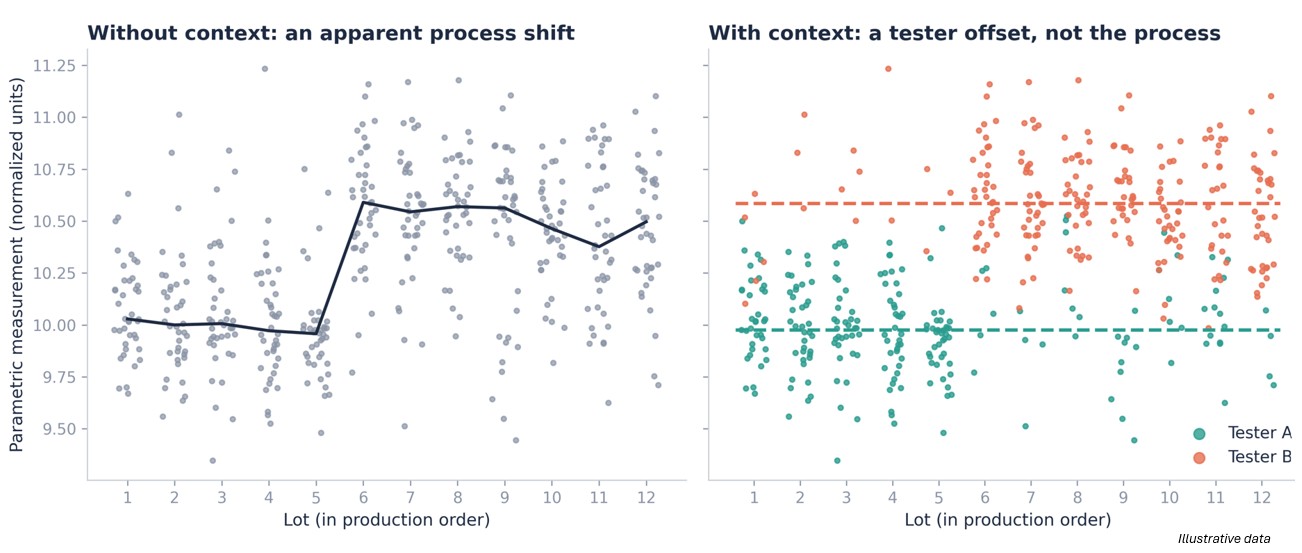
Data also changes reasoning over time. When a test is retired, a recipe is tuned or a limit is moved, the data before and after the change no longer describes the same thing. Unless those changes are explicitly mentioned with the data, any model trained is mixing two different processes.
데이터는 시간에 따라 그 의미가 변하기도 합니다. 테스트가 폐기되거나, 레시피가 미세 조정되거나, 한계치(limit)가 변경되면, 변경 전후의 데이터는 더 이상 동일한 현상을 설명하지 못합니다. 이러한 변경 사항이 데이터와 함께 명시적으로 언급되지 않는 한, 학습된 모든 모델은 서로 다른 두 가지 공정을 섞어서 학습하게 됩니다.
Where AI genuinely helps
AI can find correlations across process steps. A slow drift from one etch chamber may show up weeks later as a shifted parametric distribution at wafer sort, later as a spike in failures on final test. Connecting those dots requires linking data that may reside in tools across many departments.
AI는 공정 단계 전반에 걸친 상관관계를 찾아내는 데 탁월합니다. 하나의 식각(etch) 챔버에서 발생한 미세한 드리프트(drift)는 몇 주 뒤 웨이퍼 소트 단계에서 변동된 파라메트릭 분포로 나타날 수 있으며, 나중에는 최종 테스트에서 불량률 급증으로 이어질 수 있습니다. 이러한 점들을 연결하려면 여러 부서의 장비에 분산되어 있을 수 있는 데이터를 서로 엮어야 합니다.
AI can also help clean data. Machine learning excels at linking inconsistent identifiers, identifying physically impossible measurements, classifying wafer map patterns and extracting knowledge from unstructured maintenance and FA notes. In many groups the most impactful first AI effort won’t be a yield model. Rather it will be the effort required to make the data credible enough for a yield model to be valuable (Figure 2).
또한 AI는 데이터 정제를 도울 수 있습니다. 머신러닝은 일관성 없는 식별자를 연결하고, 물리적으로 불가능한 측정값을 식별하며, 웨이퍼 맵 패턴을 분류하고, 비정형화된 유지보수 및 불량 분석(FA) 노트에서 지식을 추출하는 데 뛰어납니다. 많은 조직에서 가장 임팩트 있는 첫 번째 AI 프로젝트는 수율 모델 자체가 아닐 것입니다. 오히려 수율 모델이 가치를 가질 수 있을 만큼 데이터를 신뢰성 있게 만드는 데 필요한 작업이 될 것입니다(그림 2).
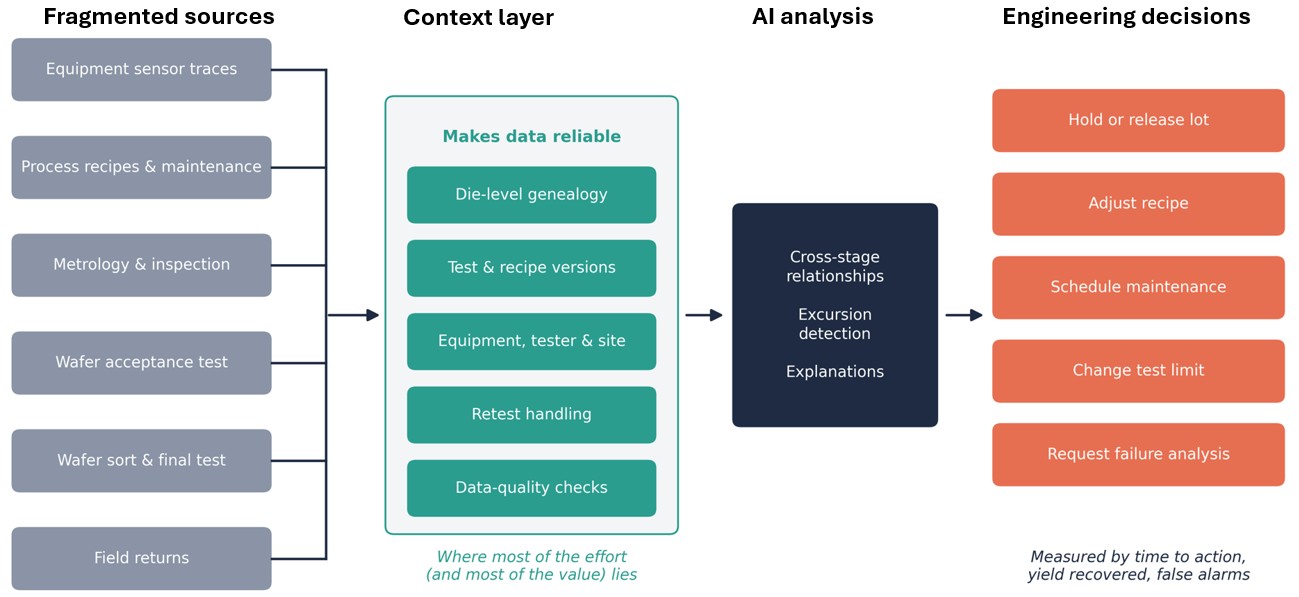
The last gap can be found between insight and action. The dashboard can indicate correlations, but correlation does not achieve yield. Someone needs to do something like change a recipe, make sure maintenance is done, check test limits or call for failure analysis. People also need to be ready to act based on the evidence. This leads to two points.
마지막 간극은 인사이트와 행동 사이에서 발견됩니다. 대시보드는 상관관계를 나타내 줄 수 있지만, 상관관계가 곧 수율 향상으로 이어지지는 않습니다. 누군가 레시피를 변경하거나, 유지보수가 제대로 이루어졌는지 확인하거나, 테스트 한계치를 점검하거나, 불량 분석을 요청하는 등의 조치를 취해야 합니다. 또한 사람들도 증거를 바탕으로 행동할 준비가 되어 있어야 합니다. 이는 두 가지 핵심 포인트로 이어집니다.
First a model must explain why it flagged something. In engineering terms that means saying what instrument was used, what step was involved and what parameter was out of range. It must be clear and precise.
첫째, 모델은 자신이 왜 무언가를 경고(flag)했는지 설명할 수 있어야 합니다. 엔지니어링 용어로 말하자면 어떤 장비가 사용되었고, 어떤 단계가 관련되었으며, 어떤 파라미터가 허용 범위를 벗어났는지 명시해야 한다는 뜻입니다. 이는 명확하고 정확해야 합니다.
Second, we should measure success by engineering performance not just how accurate the model is. The real questions are: How fast does the model detect an anomaly? How much yield can be recovered after action? How often is an alert incorrect? These are the indicators of success.
둘째, 우리는 단순히 모델의 정확도뿐만 아니라 엔지니어링 성과를 기준으로 성공을 측정해야 합니다. 실제 핵심 질문들은 다음과 같습니다. 모델이 이상 징후를 얼마나 빠르게 감지하는가? 조치 후에 수율을 얼마나 회복할 수 있는가? 경고가 잘못 울린 빈도는 얼마나 되는가? 이것들이 바로 성공의 지표들입니다.
What to do first
For teams that are starting or restarting an AI effort a few things are more important than picking an algorithm.
- Connect data at every stage from wafer sort to test and if possible, include field returns so that data can be traced back to its source.
- Give context to every measurement, including test conditions, equipment, program and recipe versions and retest status.
- Treat data quality as an engineer, with an owner rather than as a cleanup task performed before each project.
- Keep engineers in the loop by providing explanations that engineers can verify against their experience.
AI 도입을 시작하거나 재개하려는 팀에게는 알고리즘을 선택하는 것보다 더 중요한 몇 가지가 있습니다.
- 웨이퍼 소트부터 테스트에 이르는 모든 단계의 데이터를 연결하고, 가능하다면 필드 반품(field returns)까지 포함하여 데이터가 그 출처까지 추적될 수 있도록 하십시오.
- 테스트 조건, 장비, 프로그램 및 레시피 버전, 재테스트 상태를 포함하여 모든 측정값에 맥락을 제공하십시오.
- 각 프로젝트마다 마구잡이로 처리하는 뒷정리 작업이 아니라, 명확한 오너(담당자)를 두고 엔지니어의 관점에서 데이터 품질을 다루십시오.
- 엔지니어들이 자신의 경험에 비추어 검증할 수 있는 설명을 제공함으로써 엔지니어들이 루프 안에 머물도록 하십시오.
The real advantage
Algorithms are now open for everyone with models and commercial tools. What competitors cannot copy is a tightly linked well understood body of manufacturing data and an organization that knows exactly what to do with it. The semiconductor companies that win with AI will not necessarily be the ones with the sophisticated models but rather the semiconductor companies whose engineers trust their data.
이제 알고리즘은 모델 및 상업용 툴과 함께 모든 이들에게 열려 있습니다. 경쟁사들이 결코 모방할 수 없는 것은 긴밀하게 연결되어 있으며 잘 이해된 제조 데이터의 집합체, 그리고 그것을 가지고 정확히 무엇을 해야 하는지 아는 조직입니다. AI로 성공을 거두는 반도체 기업은 반드시 가장 정교한 모델을 가진 기업이 아니라, 엔지니어들이 자신들의 데이터를 신뢰하는 반도체 기업이 될 것입니다.
The views, thoughts, and opinions expressed belong solely to the speaker, and not to the speaker’s employer, organization, committee or any other group or individual.
본문에 표현된 견해, 생각, 의견은 전적으로 발표자 개인의 것이며, 발표자의 고용주, 소속 조직, 위원회 또는 기타 단체나 개인의 공식 입장을 대변하지 않습니다.
Sriram Nithin Gopal Lanka is a Senior Product Development Engineer at Advanced Micro Devices, Inc. (AMD) in Austin Texas where he has worked on DFT scan testing, memory BIST, Diagnostics, leakage testing, array repair, bitmapping, new product characterization, yield improvement and test program ownership at wafer sort and final test, and test time reduction. Before joining AMD, he was a research and development failure analysis intern at NXP Semiconductors in Austin, where he performed electrical fault isolation for new product introduction, qualification, yield enhancement and customer quality complaints. He also worked as design and validation co-op at Skyworks Solutions in Irvine CA on RF power amplifier design and measurement.
스리람 니틴 고팔 란카(Sriram Nithin Gopal Lanka)는 미국 텍사스주 오스틴에 위치한 AMD(Advanced Micro Devices, Inc.)의 선임 제품 개발 엔지니어입니다. AMD에서 DFT 스캔 테스트, 메모리 BIST, 진단(Diagnostics), 누설 전류 테스트, 어레이 복구, 비트맵핑, 신제품 특성화, 수율 향상, 웨이퍼 소트 및 최종 테스트에서의 테스트 프로그램 오너십, 테스트 시간 단축 업무를 담당해왔습니다. AMD에 입사하기 전에는 오스틴의 NXP 반도체에서 연구개발 불량 분석 인턴으로 근무하며 신제품 도입, 소자 인증(qualification), 수율 향상 및 고객 품질 불만을 위한 전기적 결함 분리를 수행했습니다. 또한 캘리포니아주 어바인에 위치한 스카이웍스 솔루션즈(Skyworks Solutions)에서 설계 및 밸리데이션 코업(co-op)으로 일하며 RF 전력 증폭기 설계와 측정을 담당했습니다.



