Why Synopsys’ Role in AMD’s Instinct MI455X Matters for AI Infrastructure
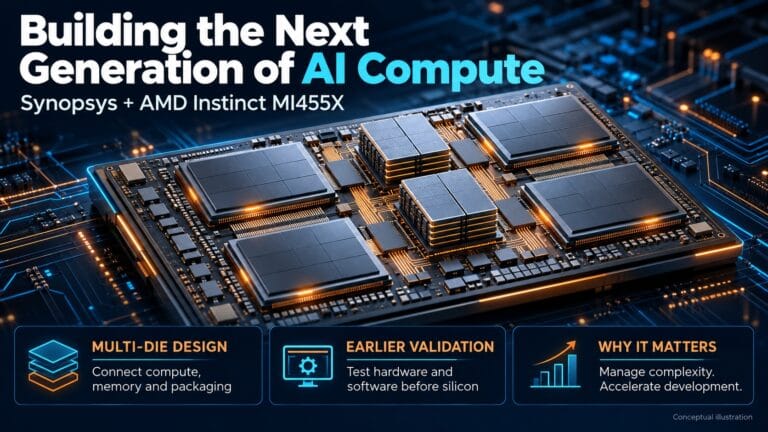
Synopsys’ collaboration with AMD on the Instinct MI455X GPU highlights a shift in how advanced AI processors are developed. Increasing performance depends on coordinating compute dies, memory interfaces, packaging, power delivery, and software. According to Synopsys’ announcement, AMD used its design, verification, and emulation technologies to manage these connected challenges and accelerate development. The significance extends beyond one accelerator: the collaboration illustrates why integrated engineering tools are becoming essential to the next generation of AI infrastructure.
시놉시스(Synopsys)와 AMD의 인스팅트 MI455X(Instinct MI455X) GPU 협력은 첨단 AI 프로세서 개발 방식의 변화를 잘 보여줍니다. 성능 향상은 이제 연산 다이, 메모리 인터페이스, 패키징, 전력 공급, 그리고 소프트웨어를 얼마나 긴밀하게 조율하느냐에 달려 있습니다. 시놉시스의 발표에 따르면, AMD는 이러한 복합적인 과제를 관리하고 개발 속도를 높이기 위해 시놉시스의 설계, 검증, 에뮬레이션 기술을 활용했습니다. 이 협력의 의미는 단일 가속기를 넘어섭니다. 통합된 엔지니어링 도구가 차세대 AI 인프라의 필수 요소로 자리 잡고 있는 이유를 명확히 보여주기 때문입니다.
At the center of the effort was Synopsys’ 3DIC Compiler, which AMD used for multi-die design and advanced package development. The platform supported partitioning, prototyping, floorplanning, automated connections between dies and the package, and integrated physical analysis. Bringing these activities into a shared workflow helped reduce manual work and allowed engineers to evaluate how individual design choices affected the overall system.
이번 협력의 중심에는 AMD가 멀티 다이 설계와 첨단 패키지 개발에 활용한 시놉시스의 '3DIC 컴파일러(3DIC Compiler)'가 있었습니다. 이 플랫폼은 분할(partitioning), 프로토타이핑, 플로어플래닝, 다이와 패키지 간의 자동 연결, 그리고 통합 물리 분석을 지원했습니다. 이러한 작업들을 단일 워크플로우로 통합함으로써 수작업을 줄이고, 엔지니어들이 개별 설계 선택이 전체 시스템에 미치는 영향을 사전에 평가할 수 있었습니다.
This matters because a multi-die accelerator must function as a coordinated whole. Dividing a processor across several dies creates opportunities for architectural flexibility, but it also introduces difficult integration problems. Connections must carry data efficiently, power must reach demanding circuitry, and heat must escape densely packed components. A design that looks effective at the individual die level can encounter bottlenecks once assembled into a complete package.
이는 멀티 다이 가속기가 하나의 조율된 전체로서 기능해야 하기 때문에 매우 중요합니다. 프로세서를 여러 다이로 나누면 아키텍처의 유연성이 높아지지만, 동시에 까다로운 통합 문제가 발생합니다. 연결 부위는 데이터를 효율적으로 전송해야 하고, 전력은 전력 소모가 큰 회로까지 도달해야 하며, 열은 조밀하게 배치된 부품들 사이에서 원활히 배출되어야 합니다. 개별 다이 수준에서는 효과적으로 보이는 설계라 할지라도, 완전한 패키지로 조립되면 병목 현상에 부딪힐 수 있습니다.
Synopsys’ integrated multiphysics analysis addressed this interaction between thermal, power, and electromagnetic behavior. These considerations influence one another. Concentrated computation produces heat, while electrical and packaging decisions affect operating conditions and reliability. Evaluating these effects together gives engineers a stronger basis for resolving tradeoffs before manufacturing. The practical value is earlier visibility into problems that could otherwise require expensive changes late in development.
시놉시스의 통합 다중물리학(multiphysics) 분석은 열, 전력, 전자기적 거동 간의 이러한 상호작용을 해결했습니다. 이러한 요소들은 서로 영향을 미칩니다. 집중된 연산은 열을 발생시키는 한편, 전기 및 패키징 관련 결정은 작동 조건과 신뢰성에 영향을 줍니다. 이러한 효과들을 종합적으로 평가함으로써 엔지니어들은 제조 단계에 들어가기 전에 트레이드오프(trade-off)를 해결할 수 있는 더 강력한 기반을 갖추게 됩니다. 실질적인 가치는 개발 후반부에 비용이 많이 드는 설계를 변경해야 할 수도 있는 문제를 미리 파악하는 데 있습니다.
Memory integration was another part of the collaboration. AMD used Synopsys memory interface intellectual property to address the platform’s performance and data movement requirements. For AI accelerators, moving information between memory and compute resources is fundamental to useful performance. Additional computing capacity delivers limited benefit when the surrounding system cannot supply data quickly enough. Memory interfaces therefore belong within the broader architectural discussion, alongside compute capability and packaging.
메모리 통합 또한 이번 협력의 중요한 부분이었습니다. AMD는 플랫폼의 성능 및 데이터 이동 요구사항을 충족하기 위해 시놉시스의 메모리 인터페이스 IP(지식재산권)를 사용했습니다. AI 가속기의 경우, 메모리와 연산 리소스 간의 정보 이동은 유용한 성능을 내기 위한 근간입니다. 주변 시스템이 데이터를 충분히 빠르게 공급하지 못한다면 추가적인 컴퓨팅 용량은 제한적인 이점만을 제공할 뿐입니다. 따라서 메모리 인터페이스는 연산 능력, 패키징과 함께 더 넓은 아키텍처 논의의 범주에 포함되어야 합니다.
The collaboration also addressed software readiness through Synopsys’ ZeBu emulation systems. AMD used these systems to validate hardware and develop software before physical silicon became available. Emulation allowed teams to exercise complex workloads, investigate performance bottlenecks, and provide feedback to designers. Synopsys also reported collaboration on emulation models supporting up to 20 billion gates, reflecting the scale of the verification task.
이번 협력은 또한 시놉시스의 제부(ZeBu) 에뮬레이션 시스템을 통해 소프트웨어 준비성 문제도 다루었습니다. AMD는 물리적인 실리콘 칩이 나오기 전에 하드웨어를 검증하고 소프트웨어를 개발하기 위해 이 시스템을 사용했습니다. 에뮬레이션을 통해 팀은 복잡한 워크로드를 실행하고, 성능 병목 현상을 조사하며, 설계자에게 피드백을 제공할 수 있었습니다. 시놉시스는 또한 검증 작업의 규모를 반영하듯 최대 200억 개의 게이트를 지원하는 에뮬레이션 모델 개발 협력 건을 발표했습니다.
Starting software work earlier matters because an accelerator’s commercial usefulness depends on more than functioning hardware. Drivers, runtime components, and other software must work with the underlying architecture. Discovering integration problems before chips arrive can help teams prepare for bring-up and reduce uncertainty. Save-and-restore capabilities further support debugging by allowing engineers to revisit relevant execution states without repeatedly starting lengthy workloads from the beginning.
소프트웨어 작업의 착수를 앞당기는 것이 중요한 이유는 가속기의 상업적 유용성이 작동하는 하드웨어 그 이상에 달려 있기 때문입니다. 드라이버, 런타임 컴포넌트 및 기타 소프트웨어는 기반 아키텍처와 원활히 연동되어야 합니다. 칩이 도착하기 전에 통합 문제를 발견하면 팀은 시스템 브링업(bring-up)을 준비하고 불확실성을 줄일 수 있습니다. 저장 및 복원(save-and-restore) 기능은 엔지니어들이 기나긴 워크로드를 처음부터 반복해서 실행할 필요 없이 관련 실행 상태를 다시 불러올 수 있게 지원함으로써 디버깅을 더욱 용이하게 만듭니다.
AMD additionally used Synopsys’ formal verification, RTL simulation, and low-power verification tools. These approaches provide complementary ways to identify errors and examine behavior across individual dies and the complete system. Their importance grows as architectures become more complex: stronger verification can improve confidence before manufacturing, when correcting a mistake generally becomes more disruptive.
AMD는 이 밖에도 시놉시스의 정형 검증(formal verification), RTL 시뮬레이션, 저전력 검증 도구를 추가로 활용했습니다. 이러한 접근 방식들은 개별 다이와 전체 시스템 전반에서 오류를 식별하고 거동을 검토할 수 있는 상호 보완적인 방법을 제공합니다. 아키텍처가 복잡해질수록 이들의 중요성은 더욱 커집니다. 제조 단계에 돌입한 이후에는 실수를 바로잡는 데 훨씬 큰 비용과 차질이 발생하므로, 더 강력한 검증은 제조 전 단계에서의 신뢰도를 높여줍니다.
For Synopsys, the announcement demonstrates how its tools span several connected stages of AI chip development. For AMD, it describes an engineering approach intended to support ambitious architectures while managing integration and schedule pressures. For the wider industry, it suggests that development efficiency increasingly depends on connecting disciplines that previously could be handled more independently.
시놉시스 입장에서 이번 발표는 자사 도구가 AI 칩 개발의 여러 연결된 단계를 어떻게 아우르는지 보여줍니다. AMD의 입장에서는 통합 및 일정 압박을 관리하면서 야심 찬 아키텍처를 지원하기 위해 고안된 엔지니어링 방식을 대변합니다. 더 넓은 산업계 관점에서 이는 개발 효율성이 이전에 더 독립적으로 다루어질 수 있었던 분야들을 얼마나 잘 연결하느냐에 점점 더 의존하고 있음을 시사합니다.
Bottom line: My takeaway is architectural and operational: as AI accelerators become increasingly interconnected systems, the ability to design, analyze, verify, and prepare software across the entire platform becomes a competitive capability in its own right for chip developers pursuing the next generation of AI infrastructure.
요약하자면: 제 관점에서의 시사점은 아키텍처적 측면과 운영적 측면 모두에 걸쳐 있습니다. AI 가속기가 점점 더 복잡하게 상호 연결된 시스템이 됨에 따라, 플랫폼 전체에 걸쳐 소프트웨어를 설계, 분석, 검증하고 준비하는 능력 자체가 차세대 AI 인프라를 추구하는 칩 개발자들에게 독보적인 경쟁력이 되고 있습니다.